

Provincial is a loaded term. It goes beyond referencing a particular region: it carries connotations of being unsophisticated, limited, somehow less than; provincial as second-best. Recent experience has shown me that if we start to look underneath the label, we can find something extremely powerful.
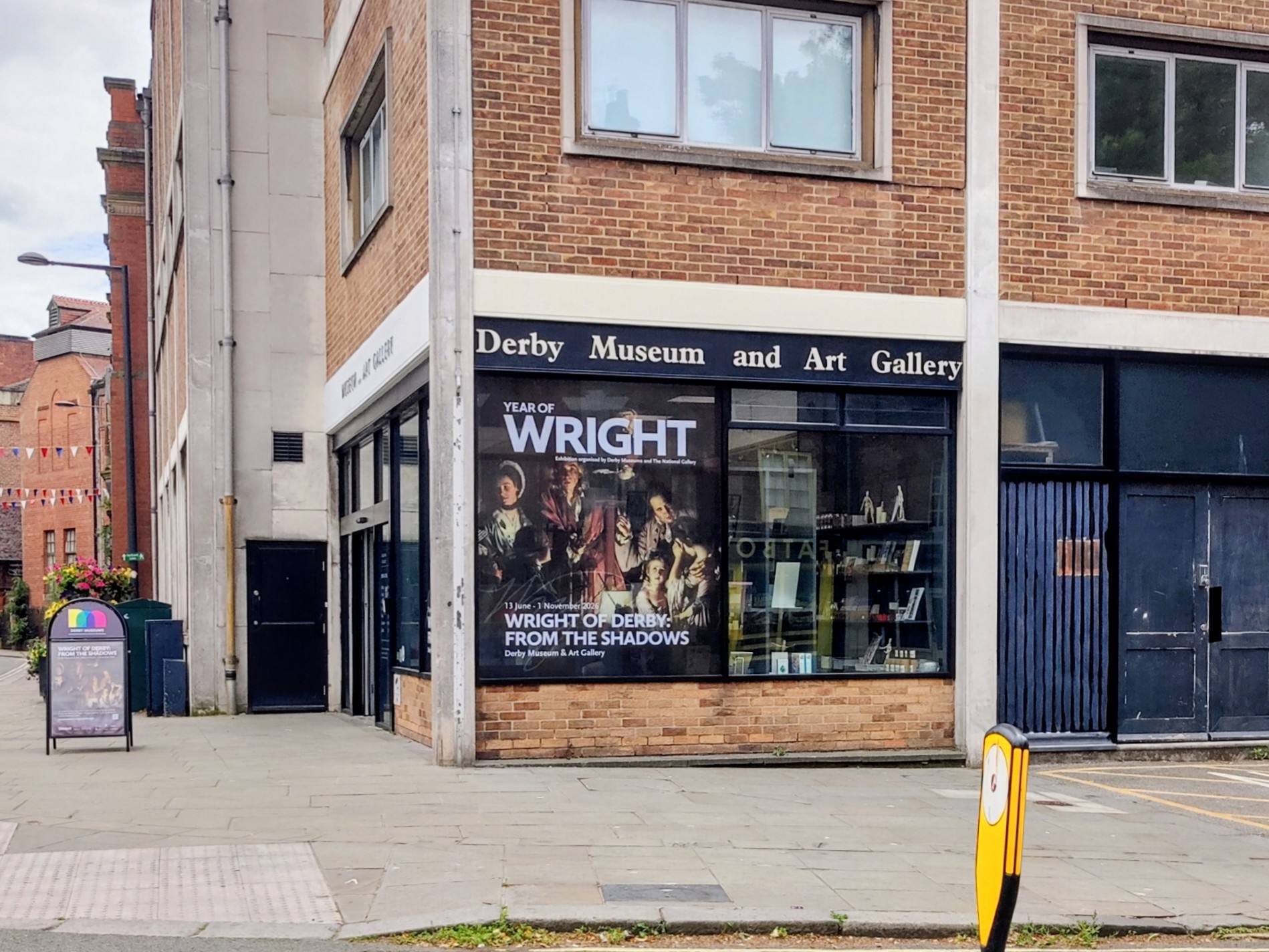
I’ve got an ongoing relationship with the ‘provincial’ artist Joseph Wright of Derby and this week I was able to attend a talk about him at Derby Museum and Art Gallery. I can’t overstate that what Derby has is really very special. A dedicated gallery and study room, the largest collection of Wright’s work in the world and expertise on hand, all in a city museum and gallery next to the taxidermy and archaeology. Wright’s legacy was championed by local people and continues to be; there is a protectiveness around the artist and his work which comes from knowing that he belongs here. Wright made work about this city, its people and its particular intellectual and industrial culture. His work is not simply in Derby; Derby is part of its meaning.
A particular focus of my studies has been about what happens to art when it moves between places, and, perhaps more importantly, what happens to its perceived value. There’s a conversation to be had about how the art world treats art differently depending on where it is. Monetary value is obviously part of this, but so is artistic value: which artists are collected, exhibited, written about and taught; which works are considered nationally significant; which museums are assumed to have the authority to tell us what matters. National institutions have enormous power in this respect. They don’t simply preserve art, they help determine what is valuable and, consequently, what is valued. But there is another kind of value which is harder to quantify.
Whilst I sat in the venue waiting for the talk to start with people, mostly retired, I observed the conversations they were having: discussions about the exhibition they’d just popped in to see, the woman drumming up support from Facebookers to help save Wright’s house, the lady next to me telling me they’re “really into our history”, before listing the times she’s heckled an expert (and sharing notes on our various tv murder tours). I listened to the answers offered and post-talk questions asked that reflected the knowledge in the room. These weren’t passive museum visitors who had come to hear someone else tell them about an artist. They knew Wright. They knew his symbolism. They knew local figures and locations. They knew the stories.
These were amateur art historians who knew more about Joseph Wright of Derby than some scholars will ever do. Are these people less of an art historian than I am, with my half a qualification and admittedly unusual amount of enthusiasm? I really don’t think so. There’s perhaps a provinciality to their art historian status too. But there is also, in the words of our speaker, a grit. A grit that gets underneath the art and the artist because they belong to the place. Work made of their city; made of them.
Whose expertise counts?
Derby is unusual in the scale and success of its focus on a major artist in a regional context. There are some similar examples I can think of: Lowry in Salford, Hepworth in Wakefield and Constable in Ipswich all have a history of building the collection of a local artist and various opportunities to research an archive, but there’s something that stands out in the way Derby tells a history of a place, not just an artist, that grounds everything.
I think about the assumptions adults make about what art history is: something difficult, academic and distant, perhaps useful for children who are already ‘arty’ but not necessarily relevant to everyone else. I want to be part of diversifying access to art history and I increasingly think that means diversifying who we think art history is for. That applies to students, academics, parents and the wider public. It also means broadening what we think counts as art worth knowing about. Children can learn art history through engaging with famous images. There is value in that. But what is really powerful is seeing art, and that can’t always mean taking a school trip to London. It needs to mean walking into the local museum and finding out who painted something on the wall. Looking closely at an object made in your own town and discovering that an artist you’ve never heard of lived three streets away. Realising that the place where you live has its own artistic history. The provincial is essential for broadening what art is.
There’s something wonderful about stepping into a local gallery (the sort run on a council shoestring but bearing the almost inevitable Friends of… stamp) and discovering a collection by an artist you have never heard of. You absorb the information and leave with a little sense of the ownership held by the community. The same is true of local history groups, village museums and the handfuls of volunteers who seem to hold the entire history of a place in their heads; working to pass it on because they know that, once they’re gone, some of that history might be gone too. That’s not lesser, that’s bloody amazing. They’re doing the things that the gate-keeping inhabitants of the academic ivory tower do but on a pension, with a committee and a fundraising coffee morning.
And this matters because we have a tendency to think of art history as something that happens somewhere else. In universities, in London, in major museums, in books written by experts, famous paintings by famous artists. Without small museums and galleries investing their energy in recording, preserving and researching local artists, enormous amounts of that history would simply disappear. It makes headlines when a painting is saved for the nation at a cost of millions of pounds and those acquisitions matter, but I think it deserves the same sense of urgency to save the rich heritage of art that survives because it’s cared for by people whose names will never make the headlines.
Where is the centre?
Perhaps this is why the word provincial bothers me. It describes geography, but it also describes a hierarchy. Recent scholarship has challenged the idea that provinciality is an inherent quality of a place. Instead, it can be understood as a relational status: somewhere becomes ‘provincial’ in relation to somewhere else that has been positioned as the centre, implicitly placing its stories, collections and expertise further away from importance. That feels particularly relevant to Joseph Wright.
His association with Derby is central to his identity as an artist, yet his work can look different when framed through the authority of a national institution in London. The centre helps construct the periphery, and then the periphery is judged against it.
Derby Museum and Art Gallery holds an interesting position as a bridge between these different spaces. Perhaps the answer isn’t to stop looking towards the centre, but to look in both directions. Recognise that art history doesn’t only belong to the national collections, the metropolitan museums or the academic institutions. It belongs to the people who read and look and research and ask questions at talks and volunteer to keep village museums open and discover an artist from their own town.
There is a particular kind of power in that provincial art history: it doesn’t just ask what art is worth, it asks what it means to the people who live with it.
Exhibition details
Wright of Derby: From the Shadows
Venue Derby Museum and Art Gallery
Dates 13 June 2026 – 1 November 2026
Artists Joseph Wright of Derby
Websitehttps://derbymuseums.org/event/wright-of-derby-from-the-shadows/