

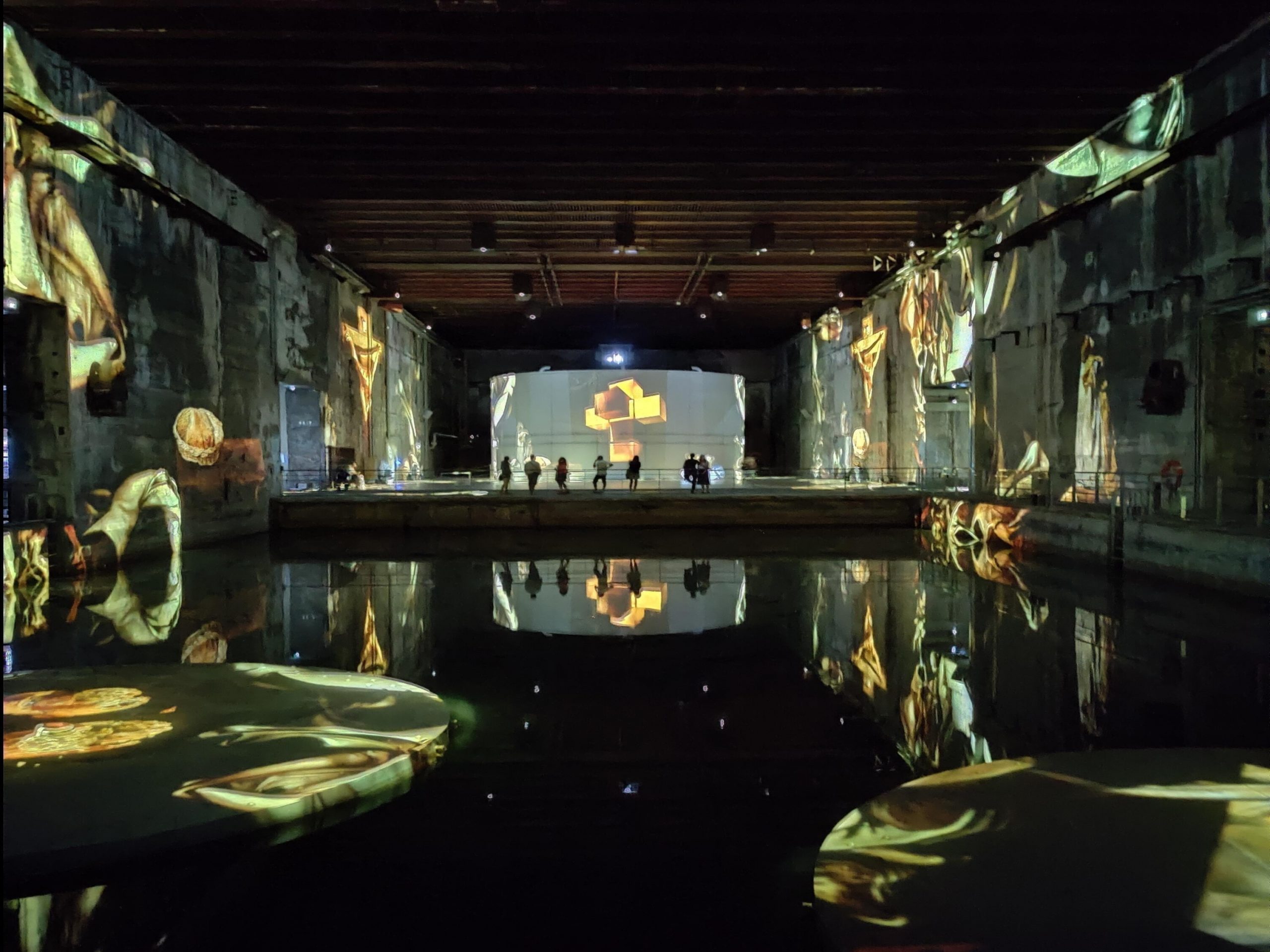
It seems that every major city now has an opportunity to immerse yourself in animated artwork, accompanied by a soundtrack of varying degrees of relevance.
Done well, these events show art in a new light, guiding visitors through an artist’s oeuvre, carefully highlighting chosen elements and stirring emotions. At the other end of the scale, however, are expensive displays of poorly animated paintings projected onto flat walls to a musical arrangement that at best can be described as ‘on-hold’.
We’ve done a few of these now. The best by far was Bassins des Lumières in Bordeaux for their Dalí and Gaudí (with a Pink Floyd soundtrack) exhibition. To be fair to all the others, this one’s in an actual submarine base, across four massive pools of water, which would feel pretty mind-blowing enough even without the projections; to be fair to Bassins des Lumières, they’ve got it really right when they could have got it spectacularly wrong. We haven’t just done massive ones though, we’ve done churches, London’s Lightroom, and, disappointingly, one in an arena. They’ve all been different and all worked to expose new audiences to art.
What works and what doesn’t.
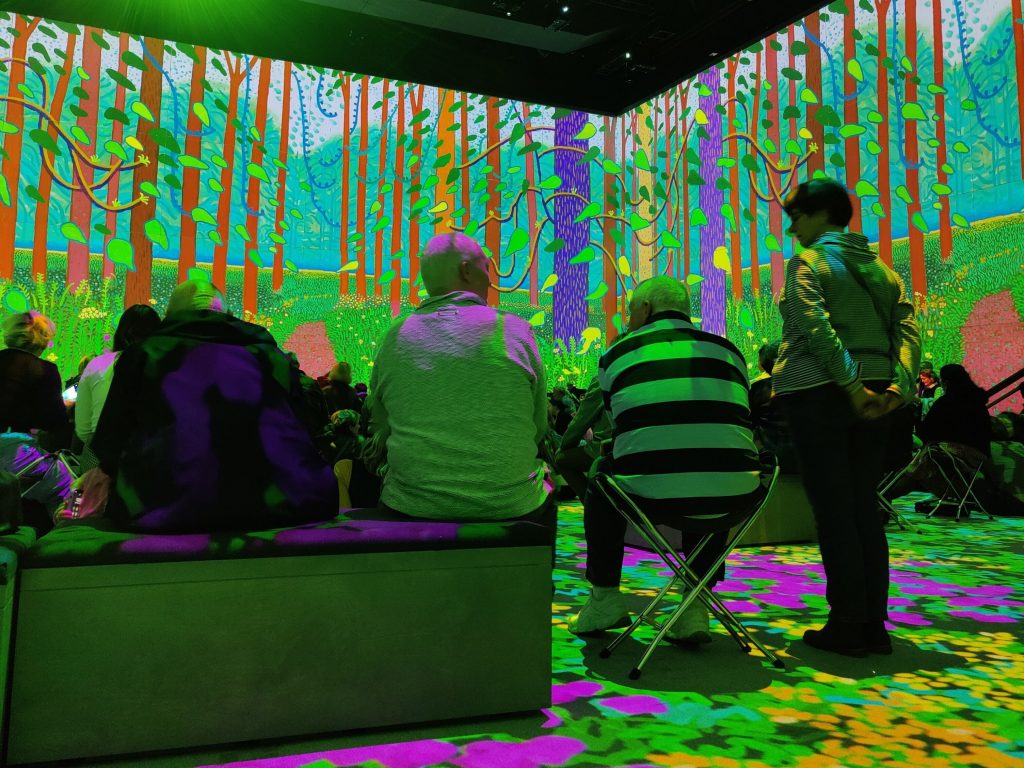
Work with the artists – It’s clearly not going to be possible with all artists, or most artists, but there are ways of doing it even if they’re not around. David Hockney was involved in his Lightroom exhibition, and it meant they told the story of his art in his words (literally) and he used the medium to his advantage. Equally though, we’ve seen Van Gogh’s work connect with the initial displays of information and integrate quotes in with the images. Essentially, each experience works well when it’s curated much as a ‘normal’ exhibition might be.
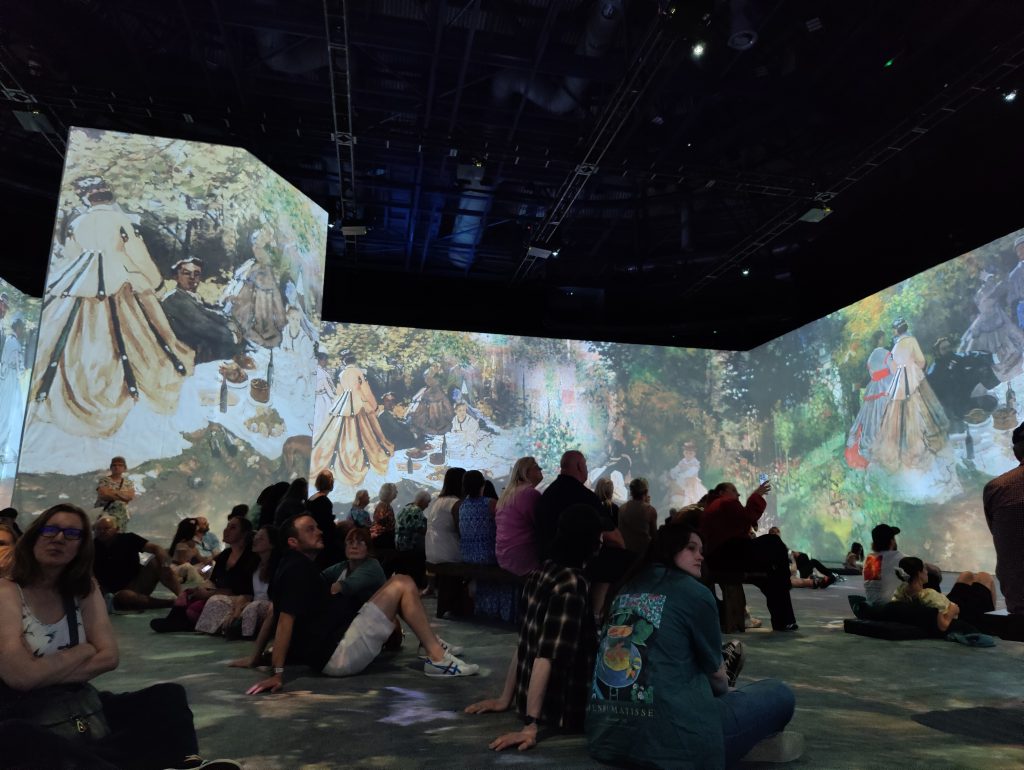
360° viewing – OK, so it won’t always be possible to project images onto the ceiling, but the roof does need to be part of the experience (even if it’s pitch black). What works is actually feeling immersed (duh). If you can see the arena roof, it’s not working.
Darkness – This links with the last point really. Obviously there will be times when the projections light the space more brightly, but for it to have the biggest effect, immersion needs to feel intimate. Even in a room with a couple of hundred other people, you need to be able to be with your own thoughts.
Information – It really helps when there’s at least some context provided. It perhaps seems obvious, but this isn’t always the case. Sometimes there are a few information boards alongside the queue for entry (particularly handy if there are timed tickets), sometimes it’s a separate part of the exhibition, and sometimes it’s integrated into the lightshow. Things that work particularly well are a timeline of the artist/s’ life and examples of the work without the animation.
Choice of music – Perhaps a trickier one to master. It can’t distract from the art, but equally, whilst aiming for the aforementioned ‘on-hold’ might seem like it’s going to blend into the background, it usually makes it more distracting. The sweet spot (if you aren’t going for a collaboration with artist and specific musicians) is to think about matching it to what’s being shown, matching transitions, tempo of animation, and not to over-use sound effects: a subtle train horn or some rainfall is enough.
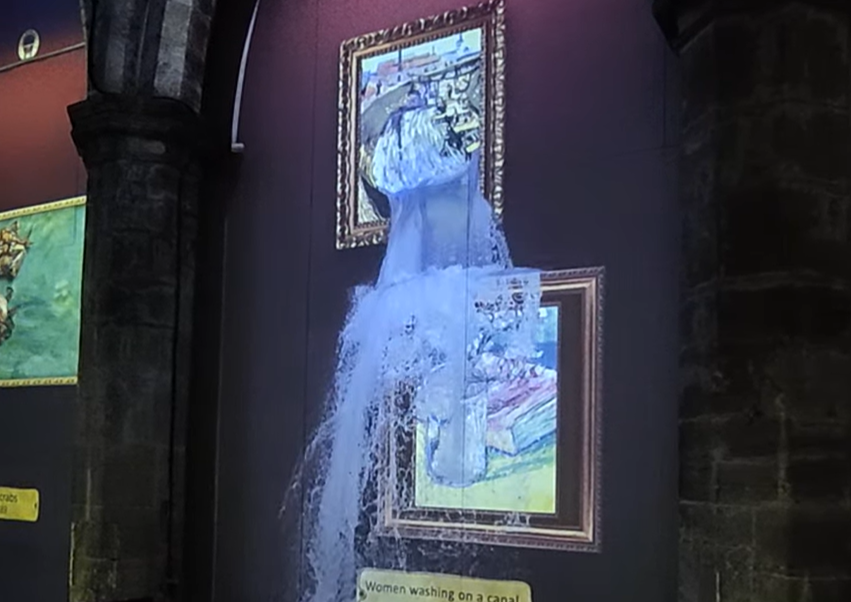
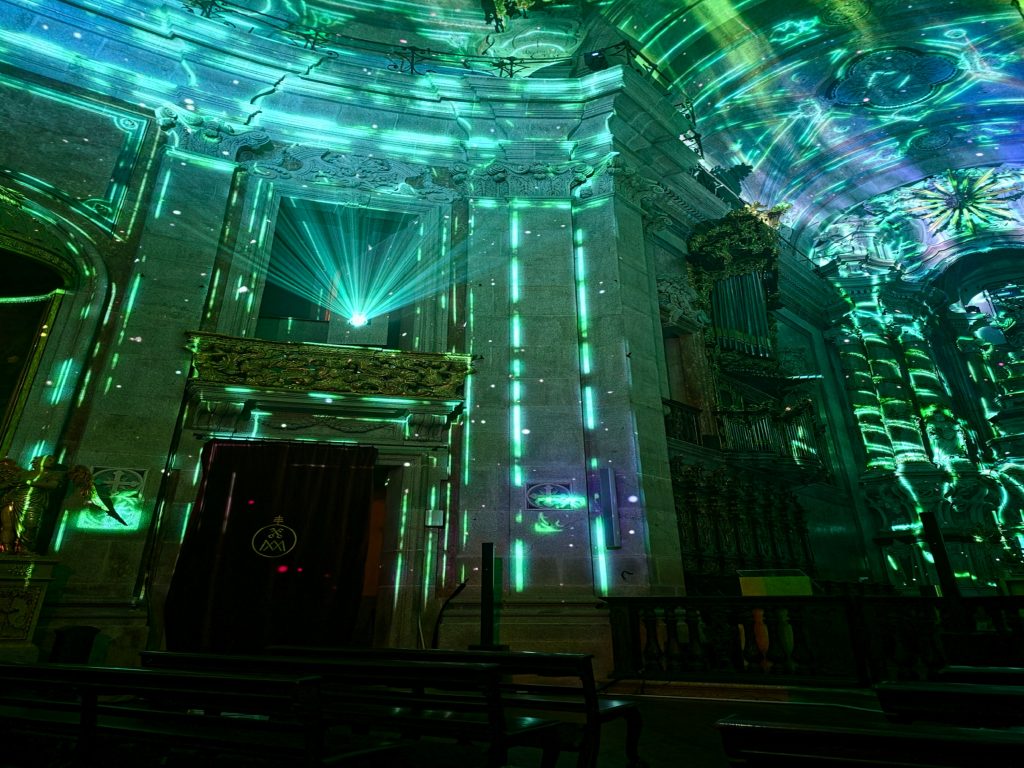
Architecture – Work with it. The best exhibitions of this kind integrate the lights with the space. Sometimes this means literally mapping the images to the arches and pillars of a building, making vines twist and water cascade over stonework, other times it’s creating height or playing with reflections. It’s about not allowing anything to distract from the display and using what’s there to enhance it, even if it’s just a massive cube.
Another thing to bear in mind is allowing people to find a corner where it’s just them. This can be done with low seating, alcoves, twisting routes or even increasing the height of the walls. There’s a connection here to earlier points on immersion.
Is it all a bit of a fad?
Yes, probably.
Will it last? Yes, in some iteration, probably.
We’re entering a time where an increasing number of late nineteenth and early twentieth-century artists’ work is entering the public domain, and with that will come the chance for their work to be used in new ways. Modernism’s breaking with tradition and experimental practices are ripe for converting to a kaleidoscopic display, and there’ll be opportunistic events alongside those that are curated with care.
One of the things that these types of show undoubtedly do is bring art to a new audience, and shows them works beyond those that they’d find with a quick search of an artist’s name. I’d love to see ways to make this turn into seeing the real thing, but I’m under no illusion that the majority of people visiting these things will leave it at that, and that’s fine. This isn’t a formal art gallery, this is art as entertainment. And as with all entertainment, there are things that work well and things that you’d give a miss the next time it comes to town. My hope is that this is a medium that’s used to showcase each artist’s unique strengths and add something extra. The best examples aren’t simply paintings made bigger; they use the possibilities of the medium to do something that a conventional gallery couldn’t.
Image References
- Bassins des Lumières – Immersive Dali exhibition. Photograph by author.
- Immersive David Hockney exhibition. Photograph by author.
- Immersive Monet exhibition. Photograph by author.
- Immersive Van Gogh exhibition. Photograph by author.
- Immersive Spiritus show at Clerigos Church in Porto. Photograph by author.