

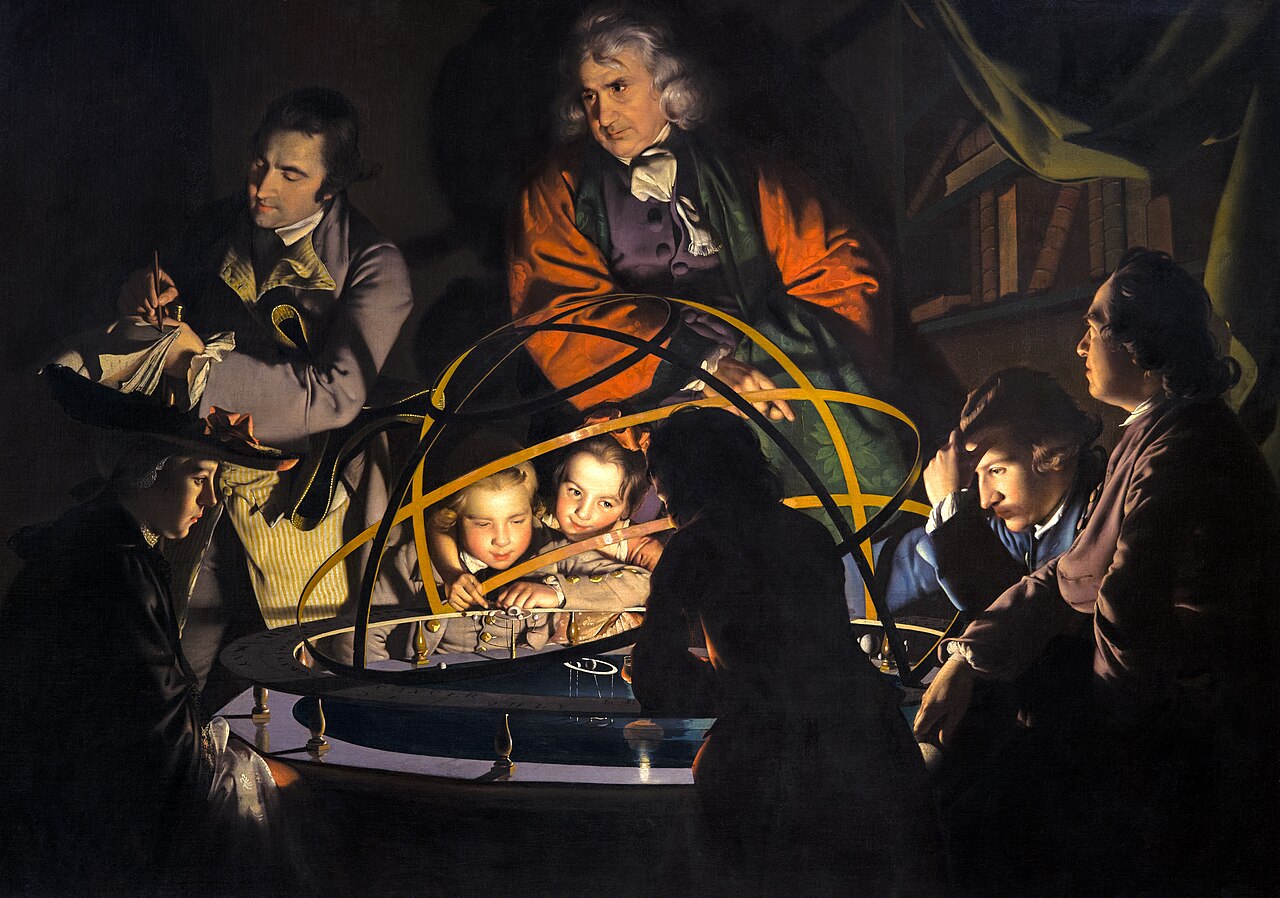
Author’s note: This essay is an abridged and revised version of an MA Art History assignment exploring institutions and geographies through Joseph Wright of Derby’s A Philosopher Giving that Lecture on an Orrery, in Which a Lamp is Put in Place of the Sun (1766). The original essay focused on the painting’s loan from Derby Museum and Art Gallery to the National Gallery’s exhibition Wright of Derby: From the Shadows. This version has been adapted for a wider audience and concludes with reflections following the painting’s return to Derby.
The loan of Joseph Wright of Derby’s A Philosopher Giving that Lecture on an Orrery, in Which a Lamp is Put in Place of the Sun (1766), commonly known as The Orrery, from Derby Museum and Art Gallery to the National Gallery offered an opportunity to reconsider a familiar work in an unfamiliar setting. Although the painting itself remained unchanged, its relocation altered the relationships through which it is understood: its connection to place, its institutional context and the experience of viewing it. The movement of artworks between regional and national collections is often presented as a practical matter of access and collaboration, yet it also raises broader questions about how meaning is produced and negotiated within museums.
Wright of Derby: From the Shadows, shown at the National Gallery between November 2025 and May 2026 before transferring to Derby, reunited Wright’s celebrated candlelit paintings for the first time in three decades. Situated in a temporary gallery adjacent to the National Gallery’s permanent collection, the exhibition’s subdued lighting and enclosed spatial arrangement echoed the thematic emphasis on illumination and shadow, producing an intimate viewing environment, distinct from the brightly lit main galleries surrounding it. Rather than functioning as a neutral backdrop, this curatorial environment actively shaped the spectator’s encounter with the works.
One of the exhibition’s most effective curatorial decisions was the relationship established between The Orrery and An Experiment on a Bird in the Air Pump (1768). Displayed on adjoining walls, the paintings immediately invited comparison. Together they present Wright’s sustained engagement with scientific enquiry, observation and the varied emotional responses of his audiences. Yet their proximity also reinforced an institutional hierarchy: The Air Pump, as part of the National Gallery’s permanent collection, occupied an established place within the museum’s narrative of British art. The Orrery, by contrast, remained a temporary visitor: closely associated with that narrative, but not fully absorbed into it.
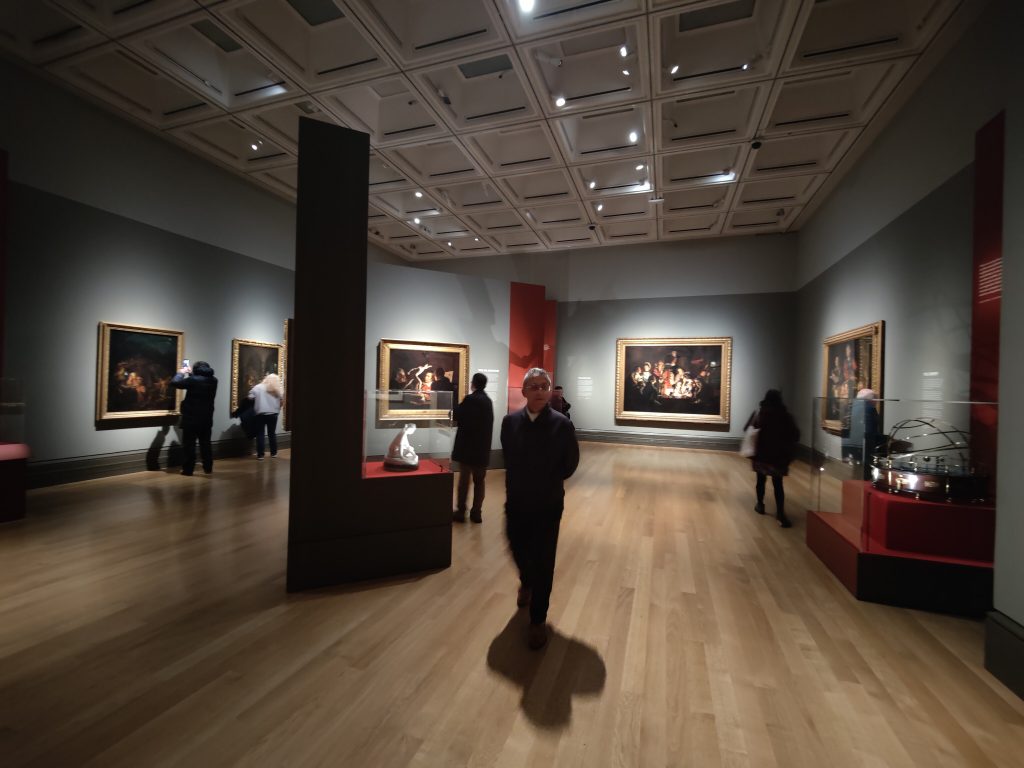
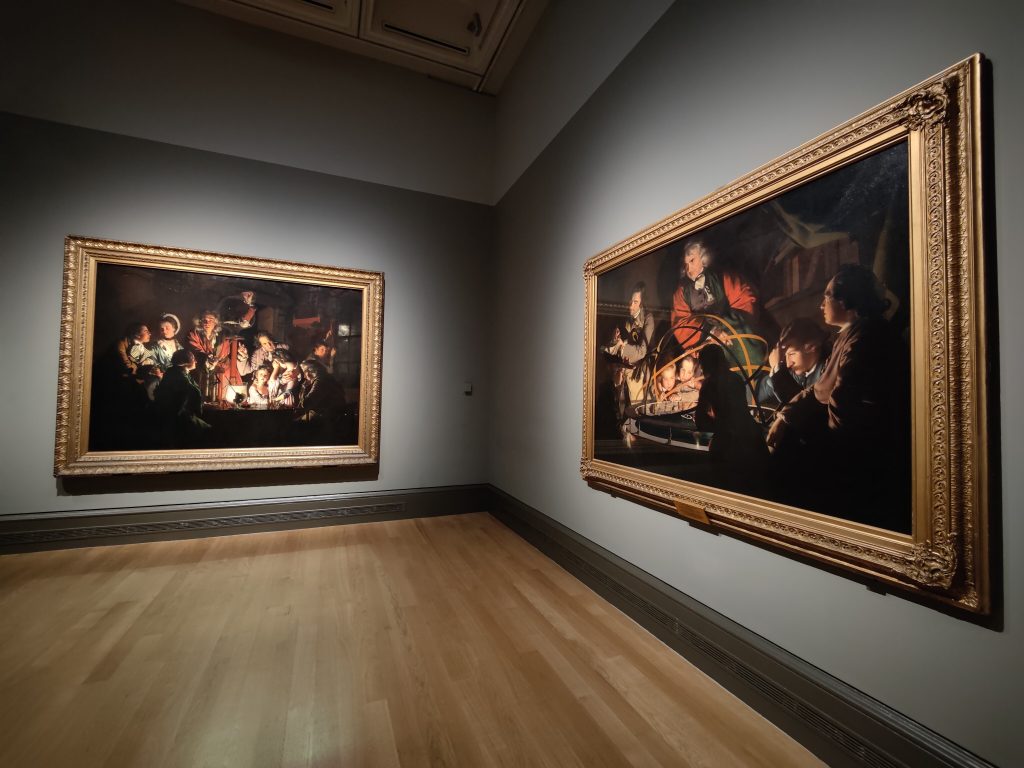
Directing visitors back into the National Gallery’s main collection, the exhibition concluded by positioning Wright alongside earlier European painters who may have informed his practice. These comparisons emphasised the ambition and originality of his work, situating him within a broader history of eighteenth-century art and encouraging visitors to see The Orrery as a masterpiece within a national collection, but they also reveal a tension between provincial and metropolitan identities, and the institutional production of artistic value.
Derby and the Provincial Enlightenment
Joseph Wright’s association with Derby extends beyond appellation. Although he trained in London and spent periods in Liverpool, Bath and Italy, his career remained closely connected to the industrial, intellectual and scientific culture of the Midlands. During the eighteenth-century, Derby was an important centre of manufacturing, innovation and public scientific enquiry. Wright moved within networks of industrialists, manufacturers and natural philosophers whose interests informed many of his most celebrated paintings. Although never a member of the Lunar Society, he shared its wider intellectual environment, depicting scientific demonstrations and experiments not as abstract celebrations of Enlightenment thought, but as social occasions rooted in provincial life.
This context distinguishes The Orrery from a straightforward allegory of scientific progress. The painting presents a gathering of adults and children assembled around a mechanical model of the solar system, each responding differently to the demonstration before them. Wright’s careful orchestration of light, gesture and expression dramatises not simply the acquisition of knowledge but the collective experience of observation itself. It reflects a culture in which scientific ideas circulated beyond universities and royal institutions, becoming part of the educational and social life of provincial England. Read in this way, The Orrery represents a specifically Midlands Enlightenment – one that challenges assumptions that intellectual innovation flowed only from metropolitan centres.
The painting reflects this provincial context through both its subject and its composition. A natural philosopher demonstrates a mechanical model of the solar system to a small audience gathered around a table, illuminated only by the concealed lamp at the centre of the instrument. Wright organises the figures around the circular form of the orrery itself, their varied gestures and expressions transforming what might otherwise have been a scientific illustration into a study of collective spectatorship. The dramatic contrasts of light and shadow guide the viewer’s eye through the composition before repeatedly returning it to the illuminated centre, recreating the act of observation for those standing before the painting.
Seen in isolation, these qualities explain why The Orrery has long been regarded as one of the defining works of eighteenth-century British painting. Its technical control, dramatic use of chiaroscuro and carefully balanced composition demonstrate Wright’s ability to unite scientific subject matter with profound engagement. Yet to understand the painting solely through these formal qualities is to overlook another important dimension of its identity.
From Artwork to Artefact
The Orrery is also a product of a particular place, shaped by the intellectual culture from which it emerged and by the institution that has preserved it for almost a century and a half. Since entering Derby’s collection in 1883, the painting has become closely associated with the city’s civic identity. Derby Museums, which holds the world’s largest collection of Wright’s paintings, drawings and letters, has played a defining role in establishing his reputation. Dedicated Joseph Wright galleries, opened in 2012, position The Orrery not simply as an artistic achievement but as part of a broader narrative about Derby’s scientific, industrial and cultural history. Its familiarity extends well beyond the museum, becoming one of the city’s most recognisable cultural images.
This dual identity, as both canonical artwork and a material expression of Derby’s intellectual heritage, becomes particularly apparent when the painting moves between institutions. Displayed within Derby Museum and Art Gallery, The Orrery exists alongside portraits of local industrialists, displays exploring regional history, and the wider story of eighteenth-century Derby. Its relocation to the National Gallery, however, invited a different reading, one in which its place within a national history of art inevitably came to the fore.
Museums do more than preserve and display works of art. Through architecture, interpretation and the relationships they create between objects, they shape the ways in which those works are understood. The anthropologist James Clifford argued that museum objects move between different systems of value. The same object may be understood primarily as an aesthetic masterpiece in one setting and as a cultural artefact in another, without either interpretation being inherently more authentic. The Orrery illustrates this fluidity particularly well. Its movement from Derby to London shifts the emphasis from local specificity towards aesthetic and canonical status, inviting the painting to be understood primarily within the broader narrative of British art without entirely relinquishing its provincial identity.
Viewing is not a neutral act, and these shifts in meaning are experienced physically as well as intellectually. The Orrery is intensely participatory; the viewer is drawn into the circle surrounding the illuminated instrument. In Derby, approached through displays of local archaeology and natural history, and facing Wright’s portraits of local industrialists such as Richard Arkwright, the painting takes on the identity of artefact; a record of provincial Enlightenment culture. Within the context of the National Gallery, the painting is detached from this provincial context and is more readily understood as a canonical masterpiece. Neither reading is more authentic than the other, but each demonstrates how institutional context shapes embodied experience.
The loan also raises wider questions about the relationship between regional and national collections. National museums inevitably possess a visibility and authority that regional institutions cannot easily match. Display within the National Gallery places The Orrery before new audiences and reinforces Wright’s position within the canon of British art, yet this process is not entirely neutral. As the painting enters a national narrative, the distinctiveness of its provincial origins risks becoming less visible. This does not suggest that Derby and London occupy opposing positions, rather the exhibition demonstrated how cultural identity is negotiated through relationships between places rather than determined by them.
The Orrery’s temporary relocation to London did not erase its identity, but it did reveal how readily provincial histories can be absorbed into broader national narratives. At the same time, the exhibition’s close collaboration with Derby Museums ensured that the painting’s regional origins remained visible, preventing its complete assimilation into the National Gallery’s story of British art.
Returning to Derby
The return of The Orrery and The Air Pump to Derby Museum and Art Gallery offered an opportunity to reconsider the argument made above. If meaning is negotiated through institutional context, what changes when the paintings return to the place most closely associated with Wright’s identity?
The most immediate difference is one of emphasis. While The Orrery and The Air Pump remain displayed on perpendicular walls, echoing the arrangement established in London, the sequence of encounter is reversed. Entering the exhibition, it is The Orrery that first commands attention. This is, no doubt, a consequence of the gallery’s architecture rather than an explicit curatorial statement, yet the effect is nonetheless significant. In London, The Air Pump acted as the visual anchor of an exhibition situated within the National Gallery’s established narrative of British art. In Derby, The Orrery resumes a more prominent position, producing what feels less like a reversal of hierarchy than the restoration of an existing relationship between painting, museum and place.
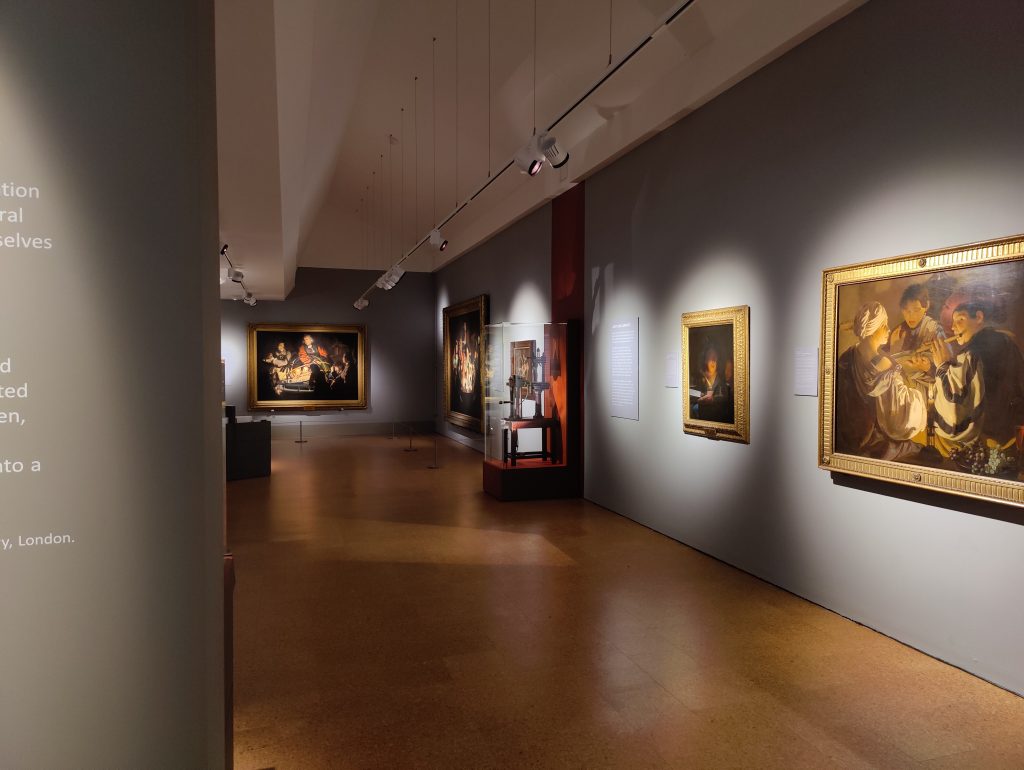
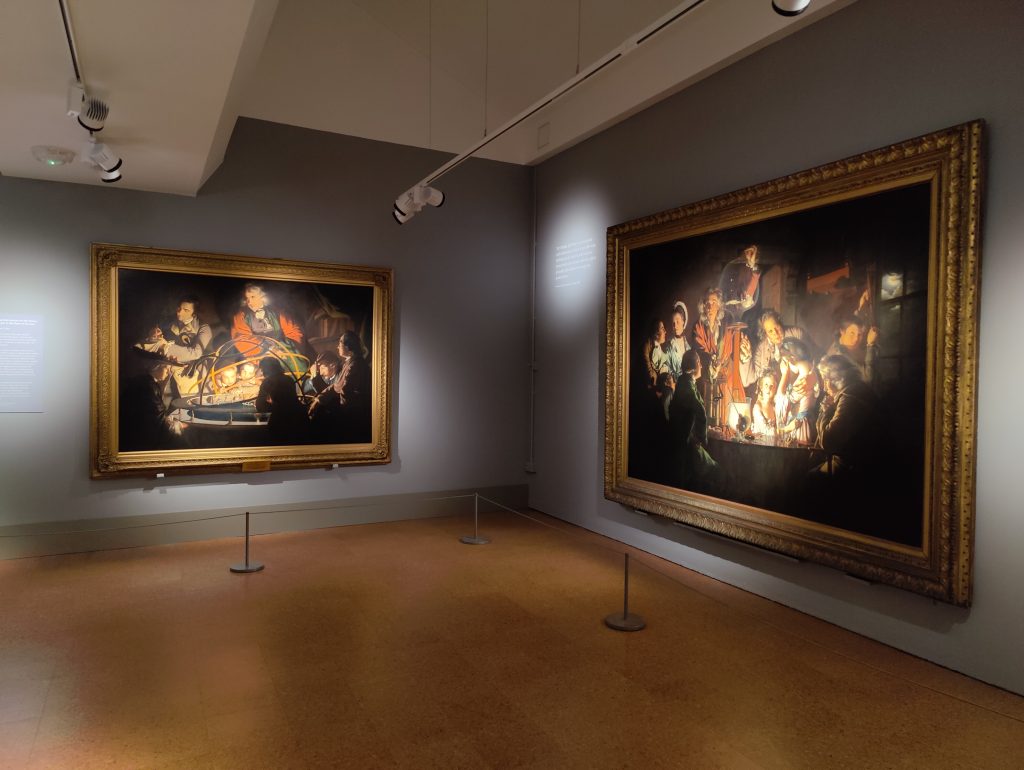
This distinction extends beyond the position of individual works: the exhibition occupies a different institutional role within Derby Museum and Art Gallery from that which it held in London. At the National Gallery, Wright of Derby: From the Shadows existed alongside one of the world’s best-known collections; a temporary intervention within a larger narrative. In Derby, the exhibition forms part of the museum’s central identity. The surrounding displays, include works drawn from Derby’s own collections, rooting Wright’s paintings within the civic, industrial and intellectual history from which they emerged. Rather than supplementing an existing story, the exhibition becomes part of the museum’s ongoing account of the city itself.
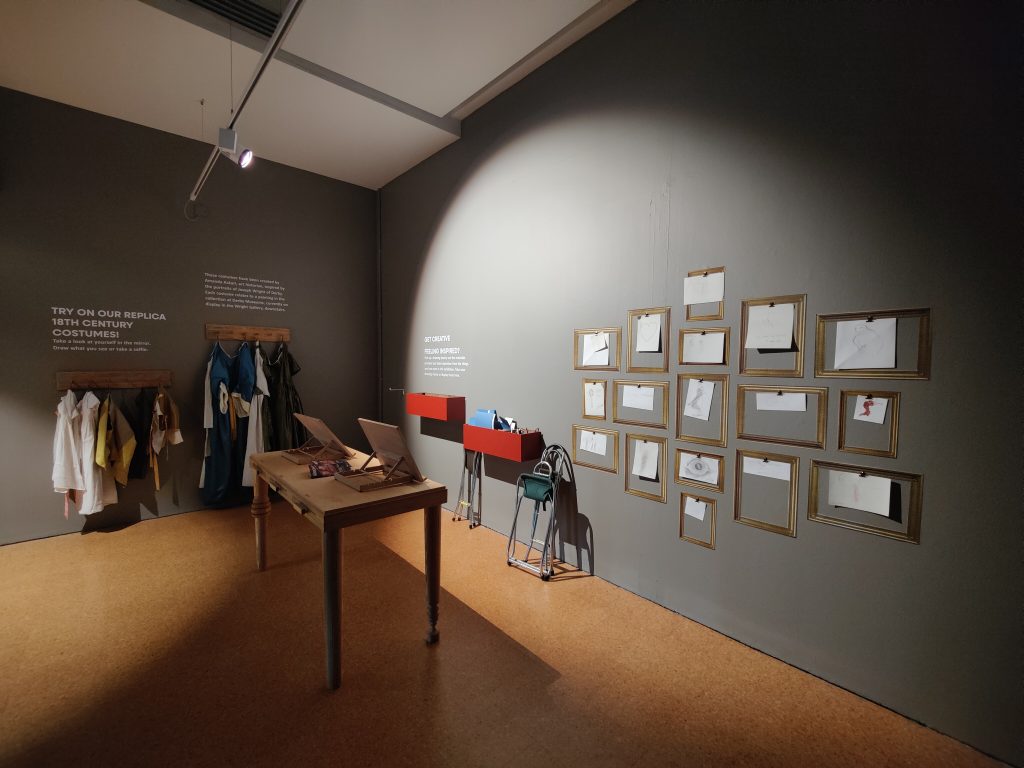
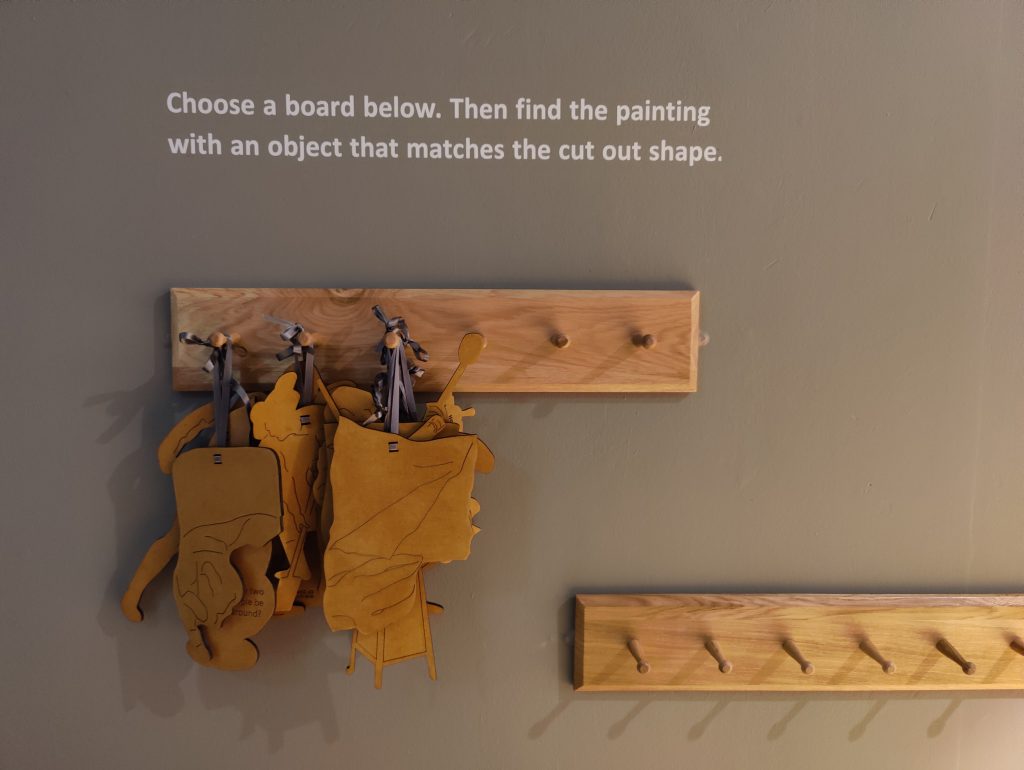
The audience also appears different. The atmosphere is less prescribed than in London, with a greater sense of visitors moving between spaces at their own pace. Lower hanging heights, family activities and opportunities for younger visitors encourage engagement without diminishing the seriousness of the works on display. The exhibition remains scholarly in its interpretation, yet it also reflects the role of a regional museum in serving local audiences as well as specialist visitors. This broader welcome reinforces the sense that Wright belongs here – not because his work is somehow diminished by its provincial setting, but because it continues to function as part of a living civic collection rather than solely as an object of national acclaim.
The return of The Air Pump is equally revealing. During its loan to Derby it inevitably carries the prestige associated with the National Gallery, and its prominence in publicity across the city reflects its status as one of Wright’s best-known paintings. Yet once installed within Derby Museum and Art Gallery, that metropolitan association quickly recedes. Displayed in the building with portraits of Richard Arkwright and other figures central to Derby’s industrial history, and galleries that connect art with archaeology, science and local identity, The Air Pump is drawn into the same network of relationships that has long shaped readings of The Orrery. It, too, shifts between systems of value, becoming not only a celebrated masterpiece but also part of Derby’s material and intellectual heritage.
Recent discussions of provinciality have argued that the “provincial” is not a fixed geographical condition but a relational one, produced through comparison with centres of cultural authority. There was reason to wonder whether the collaboration between Derby Museums and the National Gallery might reinforce precisely such a hierarchy, presenting Derby as the provincial origin from which Wright’s paintings briefly travelled to receive national validation. Instead, the exhibition suggests something more reciprocal. The National Gallery undoubtedly extends Wright’s visibility and confirms his place within the canon of British art, but the return to Derby demonstrates that national recognition need not displace local identity. If anything, the collaboration reinforces Derby’s longstanding role in shaping Wright’s reputation.
Matthew Craske has argued that Wright was himself acutely aware of the opportunities afforded by exhibiting in London while choosing to remain based in Derby, building a national reputation without relinquishing his provincial identity. The journey of The Orrery seems to echo that balance; temporary relocation broadens the contexts within which it can be understood, but its return demonstrates that those wider narratives need not come at the expense of the local histories from which they developed.
Seen across both exhibitions, The Orrery confirms that its meaning is neither fixed within the painted surface nor determined by a single institution or place. Rather, it is continually renegotiated through movement between audiences, museums and geographical contexts. There is a striking parallel between the painting’s journey and Wright’s own career. Although he sought recognition through London’s exhibition culture, he remained rooted in Derby; the continued use of the name Joseph Wright of Derby reflects that enduring balance. In much the same way, The Orrery emerges not as a work whose meaning is resolved by national recognition, but as one whose significance depends upon its ability to inhabit both provincial and national narratives simultaneously. Far from diminishing its local identity, its place within the national canon ultimately reaffirms the importance of the city from which both the artist and the painting continue to draw their name.
Selected Bibliography
Barker, Elizabeth E. 2000 ‘New Light on ‘The Orrery’: Joseph Wright and the Representation of Astronomy in 18th-Century Britain.’ The British Art Journal, vol. 1, no. 2. pp. 29–37. https://www-jstor-org.libezproxy.open.ac.uk/stable/pdf/41614962 [Accessed 24 May 2026]
Clifford, James. 1988 ‘On collecting art and culture’, in The Predicament of Culture: Twentieth Century Ethnography, Literature and Art, (Cambridge, MA, Harvard University Press), pp. 215–29 Available at: https://doi-org.libezproxy.open.ac.uk/10.4159/9780674503724 [ Accessed 10 May 2026]
Craske, Matthew. 2020 Joseph Wright of Derby: Painter of Darkness (London: The Paul Mellon Centre for Studies in British Art)
Diamond, Pauline. 2013 ‘Joseph Wright of Derby (1734–1797): The Importance of a Local Museum in the Formation of an Artist’s Reputation.’ The British Art Journal, vol. 14, no. 1. pp. 18–23. https://www-jstor-org.libezproxy.open.ac.uk/stable/pdf/43492015 [Accessed 24 May 2026]
Riding, Christine. and King, Jon. 2025 (eds) Wright of Derby: From The Shadows, exh cat. (London: The National Gallery)
Exhibition Details
Wright of Derby: From the Shadows Temporary exhibition, November 2025 to May 2026. The National Gallery, London
Wright of Derby: From the Shadows Temporary exhibition, June 2026 to November 2026. Derby Museum and Art Gallery, Derby