

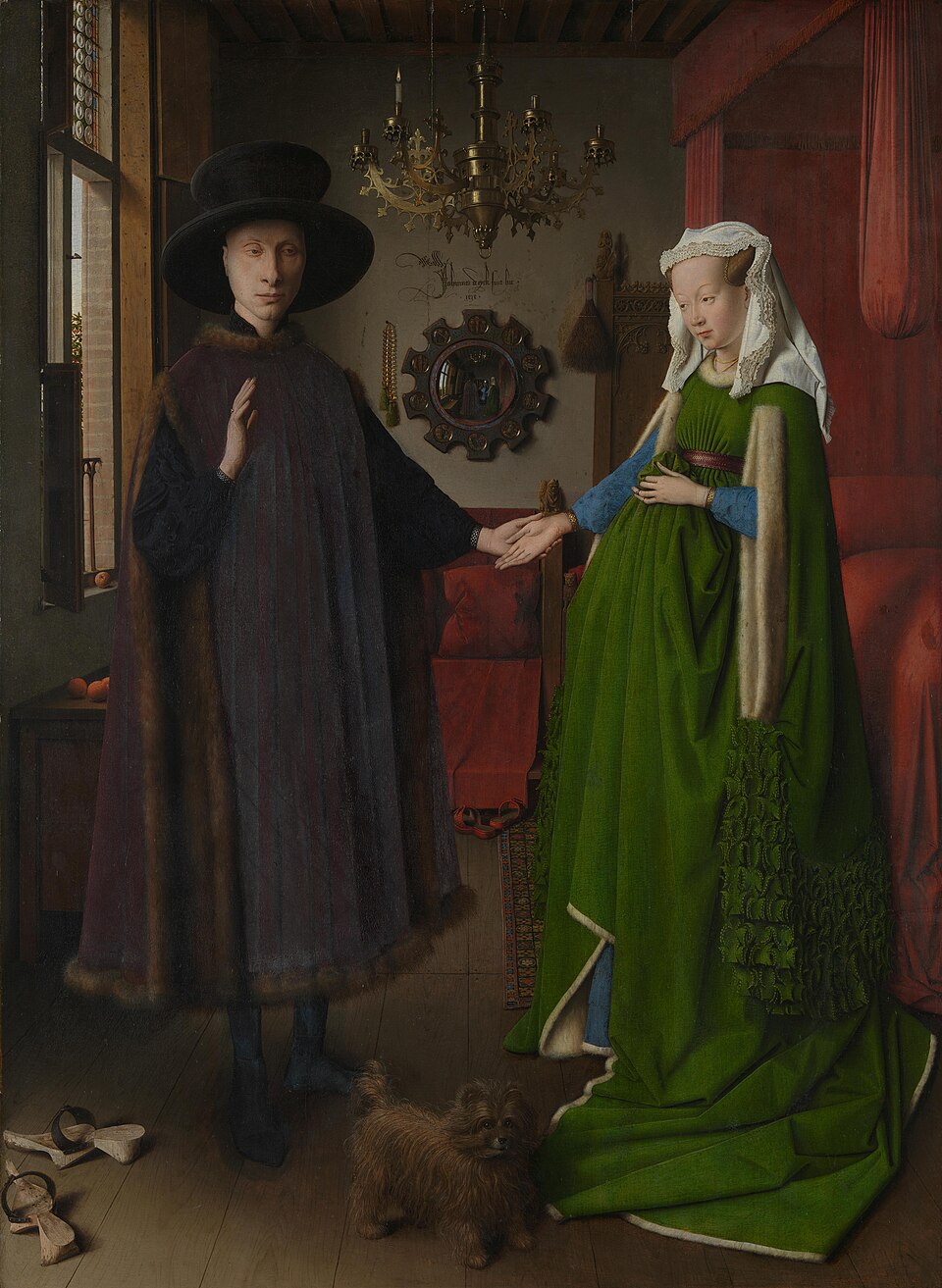
The Arnolfini Portrait by van Eyck is one of the most analysed paintings in Western art history; famed for its pioneering use of oil paint and network of hidden symbolism.
Reading the Work
Visual analysis
The painting depicts a richly dressed, fifteenth-century man and woman standing in a carefully arranged domestic interior. The composition is dense with objects, including a convex mirror, chandelier, bed, oranges, a small dog, and discarded wooden clogs, all contained within a shallow pictorial space that draws attention to every detail. The figures are organised along a strong vertical axis, with the convex mirror acting as the visual centre of the painting. Van Eyck’s controlled use of light illuminates textures such as fur, fabric, wood and glass with extraordinary precision, demonstrating his mastery of oil paint. The viewer is positioned as an observer, almost as a witness entering the private space, encouraged to examine the carefully constructed interior and its many visual details.
Materiality and Technique
Van Eyck’s Arnolfini Portrait demonstrates the remarkable possibilities of oil paint on an oak panel, a medium that enabled an unprecedented level of precision and luminosity in Northern Renaissance painting. Through the application of multiple translucent glazes, he achieves convincing representations of diverse materials, from the soft fur trim of the garments to the polished wood of the furniture, the reflective glass of the convex mirror, and the gleaming brass chandelier. These carefully layered techniques create subtle tonal transitions, depth, and an illusion of tactile surfaces. The painting exemplifies the technical innovation of Northern Renaissance artists, showcasing oil painting as a medium capable of combining meticulous naturalism with exceptional visual richness.
Re-encountering the Work
The Curator
From a curatorial perspective, the Arnolfini Portrait is experienced not only as a fifteenth-century object but also as a carefully staged encounter. Its relatively modest scale encourages close viewing, inviting visitors into an intimate domestic scene. Controlled gallery lighting can be used to enhance the reflective qualities of the oil paint, particularly in the convex mirror and metallic surfaces, while revealing Van Eyck’s intricate detail. The painting’s framing and placement should reinforce the viewer’s role as a witness, echoing the function of the mirror within the composition. Curatorial decisions shape the work’s atmosphere, transforming a private interior into a shared public experience.
The Social Historian
From a social historian’s perspective, the Arnolfini Portrait provides valuable insight into the social structures and material culture of fifteenth-century Europe. The painting reflects the importance of marriage as both a personal and economic institution, while the lavish clothing, imported oranges, oriental carpet and finely furnished interior demonstrate the wealth of a prosperous merchant household. These luxury goods also reveal the extensive trade networks connecting Northern Europe with the Mediterranean and beyond. Everyday objects and domestic rituals become evidence of contemporary customs, status and identity, allowing the painting to function not only as a work of art but also as a visual document of late medieval society.
The First-Time Visitor
Encountering the Arnolfini Portrait for the first time, a visitor may initially feel uncertain about what is taking place within the scene. The small scale of the painting creates a sense of intimacy, yet the overwhelming amount of detail and ambiguous expressions of the subjects invite prolonged examination. The viewer may be drawn to the mysterious convex mirror, which expands the space and reveals figures beyond the main subjects, creating questions about presence and observation. The carefully arranged objects, gestures, and expressions suggest a significant event, but its exact meaning remains unclear: Are the couple celebrating or mourning? Is the woman pregnant? Why was it painted? This ambiguity encourages curiosity, transforming the experience into one of discovery and close visual investigation.
What Changes When We Change the Lens?
There is a tension between reading it as document, symbol, and experience of presence. No single interpretation holds.
Try it yourself
- Is there a “core” meaning here, or only structured readings?
- How do different methods produced different meanings?
- How does professional interpretation differ from visitor interpretation?
- How do museums “shape” understanding through interpretation?
- How might an economist, a film-director or a child see the painting?