
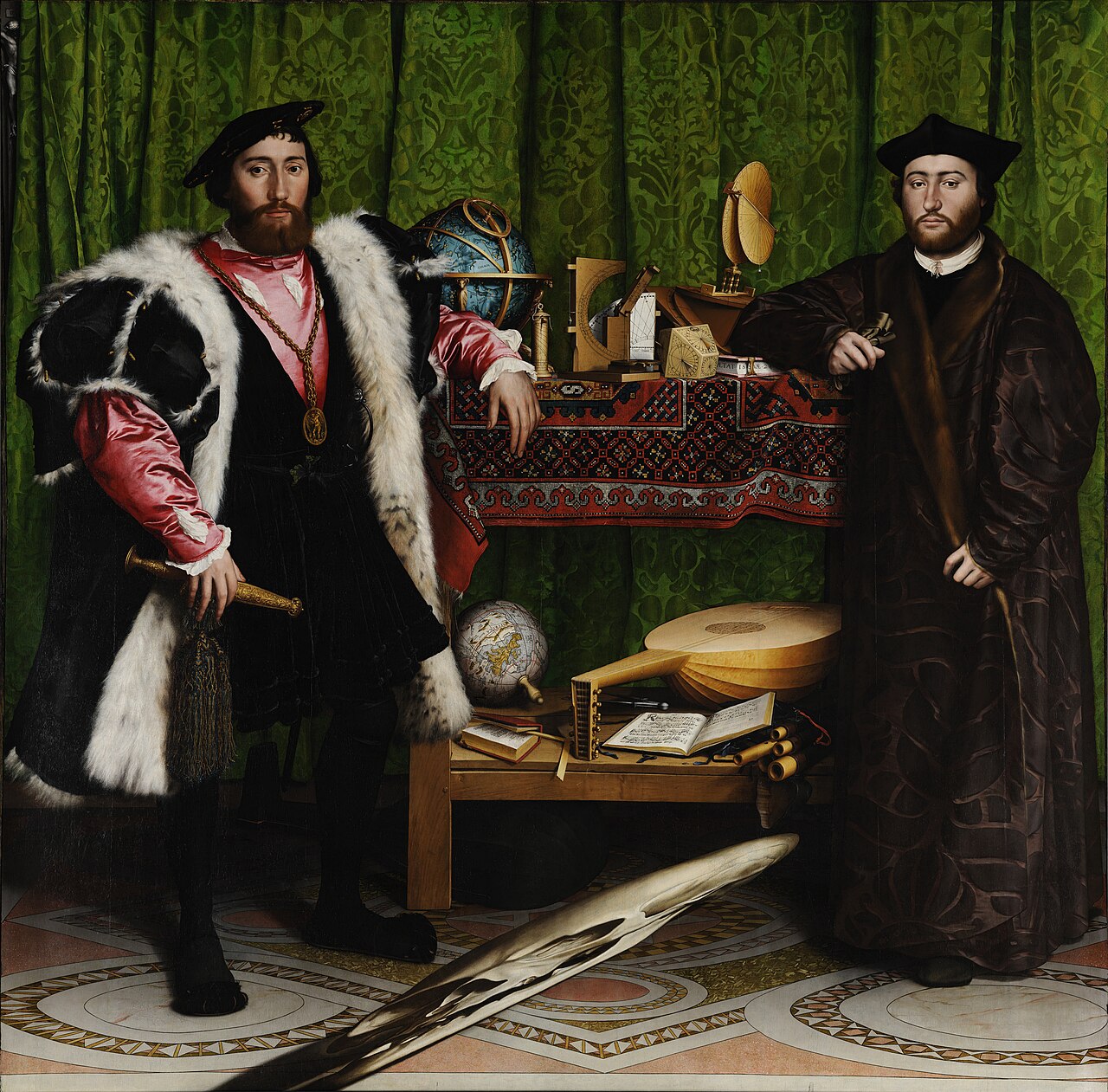
The Ambassadors by Holbein is probably best known for its complex, layered symbolism and striking anamorphic skull across the foreground, visible when looked at from a specific angle.
Reading the work
Iconography
Holbein’s The Ambassadors depicts two richly dressed figures surrounded by an array of objects that communicate ideas about knowledge, power and the relationship between earthly and heavenly realms. The scientific instruments, celestial globe and books represent human understanding of the cosmos, while the terrestrial objects reference exploration and specific places of political significance. A broken string of the lute and missing flute suggest disharmony, while the upside-down globe symbolises a world in disorder and the prominent inclusion of an anamorphic skull reminds viewers of human mortality. The patterned floor, identifiable as the Cosmati pavement of Westminster Abbey, and the table’s altar-like arrangement further connect the painting to ideas of faith, power and uncertainty.
Contextual History
Viewed through its historical context, Holbein’s The Ambassadors reflects the political and intellectual tensions of sixteenth-century Europe. It was painted during the Reformation and reflects this period of religious conflict, shifting alliances and uncertainty across Europe. The two figures are connected to diplomatic activity between England and France, representing the importance of negotiation and international relationships and their possessions reveal the influence of Renaissance humanist culture, where education, science and classical knowledge were closely linked to social status and political influence. The work therefore functions not only as a portrait of individuals but also as a visual record of a changing world shaped by diplomacy and ideas.
Re-encountering the Work
The Diplomat
A modern diplomat might approach The Ambassadors as a study in power and political self-presentation. The painting carefully constructs the identities of its subjects through clothing and surroundings, demonstrating how authority is communicated visually – the luxurious garments and carefully selected objects act as signals of influence and international connection. Like contemporary diplomatic portraits and official photographs, Holbein’s work presents individuals through symbols designed to project credibility and status. The painting also suggests the complexity of diplomacy, where public image and hidden meanings operate together, reminding viewers that political representation is often carefully managed and strategically constructed.
The Conservator
A modern conservator would approach The Ambassadors as a complex material object requiring careful study and protection. Painted in oil on oak panel, the work presents both the strengths and challenges of Renaissance materials, including delicate layers of pigment, glazing and fine surface details. The preservation of its intricate textures, from fabric and fur to polished objects, requires controlled environmental conditions and ongoing monitoring. The anamorphic skull also presents technical questions about perspective, paint application and the relationship between distortion and viewing position. Conservators must balance maintaining the painting’s physical condition with preserving Holbein’s original intentions and the visual effects created through his innovative techniques.
The Tourist
A modern tourist encountering The Ambassadors is likely to first experience a crowd of spectators before seeing a visual puzzle filled with unfamiliar objects and hidden meanings. The immediate impact comes from the astonishing detail, from the luxurious clothing to the collection of scientific and musical instruments arranged across the composition. The strange, elongated shape across the foreground creates confusion until the viewer discovers it is a distorted skull revealed through a particular angle of vision. This moment of recognition within a crowd transforms the painting from a portrait into a joint, interactive experience. The work’s spectacle of objects and illusion encourages visitors to look closer and question what they are seeing.
What Changes When We Change the Lens?
Knowledge becomes both display and warning; interpretation depends on disciplinary priorities.
Try it yourself
- Is there a “core” meaning here, or only structured readings?
- How do different methods produced different meanings?
- How does professional interpretation differ from visitor interpretation?
- How do museums “shape” understanding through interpretation?
- How might a psychologist, GCSE history student or costume designer see the painting?