

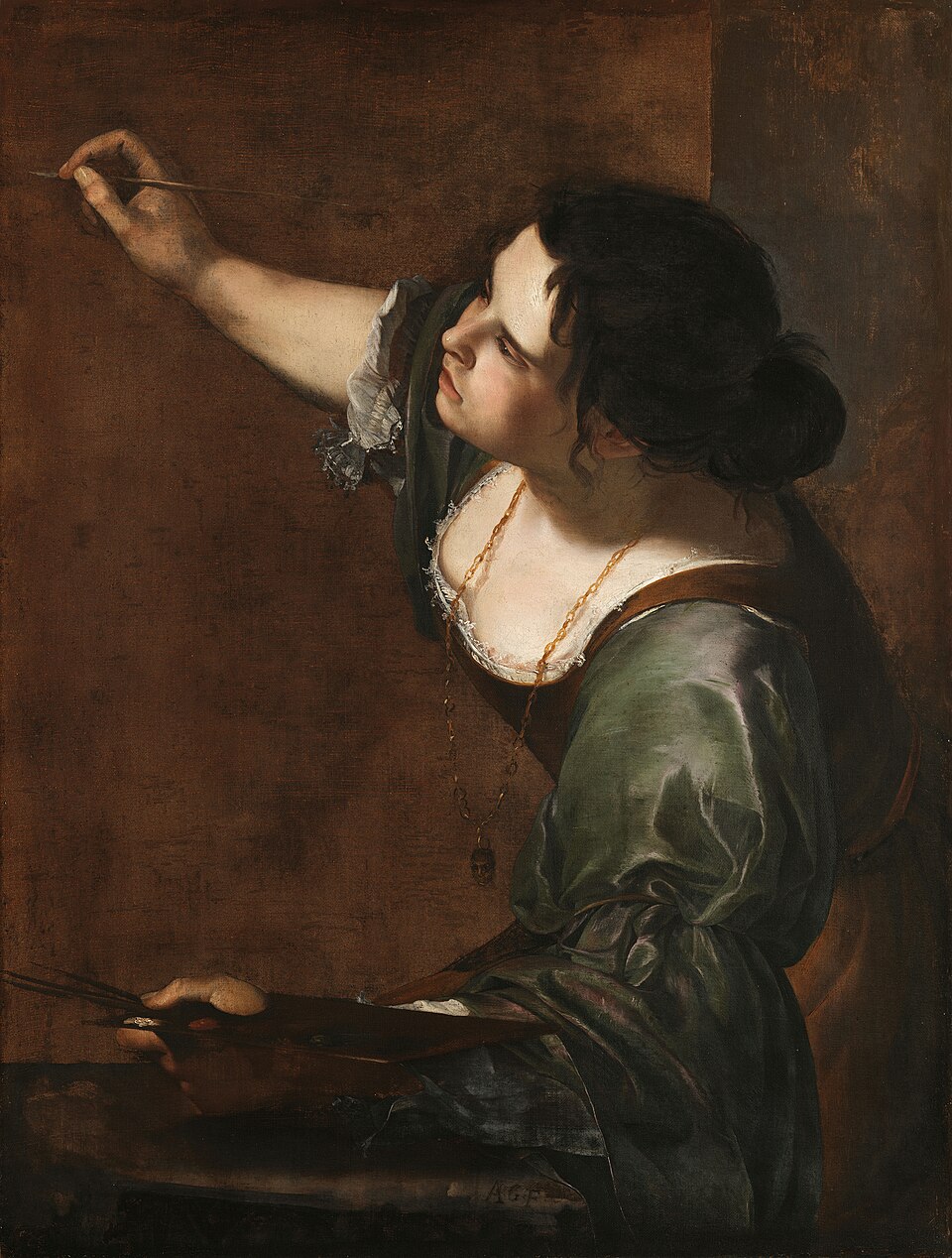
The significance of Artemisia Gentileschi’s Self-Portrait as the Allegory of Painting lies in its subversion of traditional male-dominated art history, allowing her to claim both the physical and intellectual mastery of her craft.
Reading the Work
Formal analysis
Artemisia Gentileschi’s Self-Portrait as the Allegory of Painting depicts the artist actively engaged in the act of painting, creating a composition driven by movement rather than stillness. A strong diagonal arrangement of the body, arms and brush directs the viewer’s eye across the canvas, while dramatic contrasts of light and shadow heighten the sense of depth and energy. Foreshortening of the arms and torso reinforces the illusion of physical action, drawing the viewer into the creative process. Unlike traditional portraits, Gentileschi avoids direct eye contact, remaining absorbed in her work and emphasising artistic practice over self-display.
Contextual history
Viewed within its historical context, Self-Portrait as the Allegory of Painting reflects the opportunities and limitations experienced by women artists in seventeenth-century Europe. Artistic training was largely organised through workshops, where women often faced restricted access, making Gentileschi’s professional success highly unusual. By depicting herself as the personification of Painting, she engages directly with artistic theory, particularly Cesare Ripa’s Iconologia, in which Painting was represented as a female figure. As a woman, Gentileschi uniquely embodied both the artist and the allegory, transforming an established theoretical concept into a powerful statement of professional identity and artistic legitimacy.
Re-encountering the Work
The Artist
From the perspective of an artist, Self-Portrait as the Allegory of Painting is a confident declaration of professional ambition and creative identity. Rather than presenting herself as a passive sitter, Gentileschi represents herself in the physical act of making art, emphasising skill, concentration, and intellectual authority. The painting becomes an act of self-fashioning, asserting her place within a profession dominated by men. By combining her own likeness with the allegorical figure of Painting, she claims authorship not only of the artwork but also of the identity it constructs, presenting artistic practice as central to her public reputation.
The Feminist Historian
A feminist historian might view Self-Portrait as the Allegory of Painting as a powerful challenge to the exclusion of women from artistic institutions and historical narratives. Gentileschi asserts her authorship at a time when women faced significant barriers to training, patronage and professional recognition. By embodying the allegory of Painting herself, she rejects the traditional separation between female model and male creator, presenting herself instead as the intellectual and creative force behind the work. The painting raises questions about access, authority and reputation, demonstrating how women artists actively negotiated restrictive social structures while constructing enduring professional identities.
The Conservator
A conservator approaches Self-Portrait as the Allegory of Painting as both an image and a physical object shaped by seventeenth-century materials and techniques. Close examination of the brushwork reveals confident, energetic handling that enhances the illusion of movement, while the layering of pigments creates subtle transitions between light and shadow. Scientific analysis can identify original pigments, later restorations, and changes made during the painting process, offering insight into Gentileschi’s working methods. Monitoring the condition of the paint surface, canvas, and varnish is essential to preserving the dramatic effects of light, texture, and colour that define the composition.
What Changes When We Change the Lens?
The painting shifts from self-portrait to professional manifesto.
Try it yourself
- Is there a “core” meaning here, or only structured readings?
- How do different methods produced different meanings?
- How does professional interpretation differ from visitor interpretation?
- How do museums “shape” understanding through interpretation?
- How might a poet, conservator or first-time visitor see the painting?