

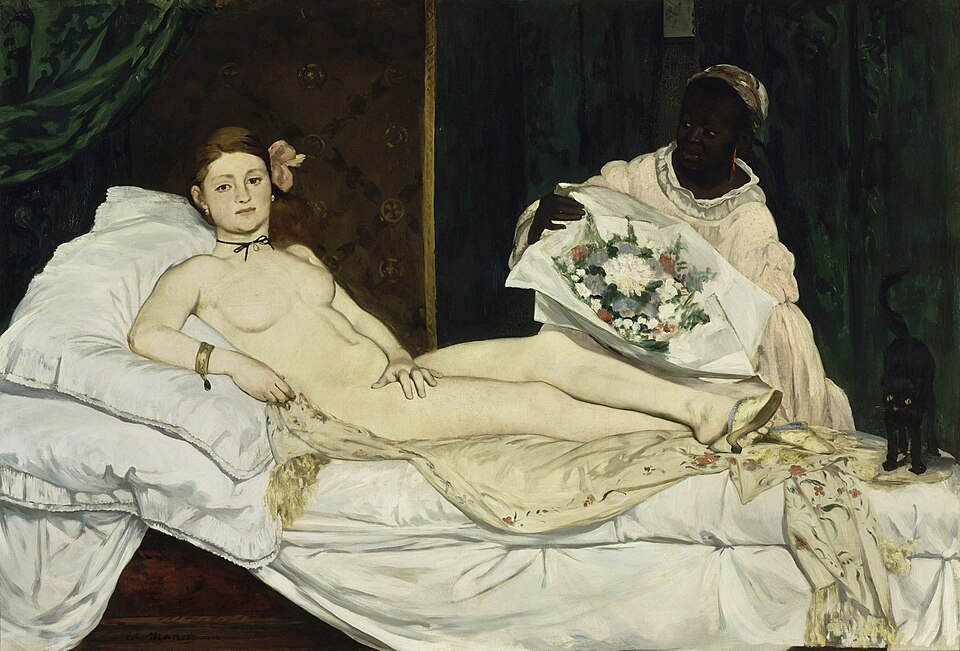
Manet’s controversial Olympia laid the foundations for impressionism and modern art by replacing the traditional, idealised classical nude with a provocative, real-life courtesan.
Reading the Work
Formal analysis
Manet’s Olympia depicts a reclining female figure positioned directly before the viewer, accompanied by a servant presenting flowers and a black cat at the foot of the bed. The painting rejects traditional academic ideals of beauty through its flatness, compressed space and direct frontal gaze. Rather than creating an illusion of idealised three-dimensional form, Manet uses strong contours and simplified areas of tone alongside visible brushwork to emphasise the surface of the canvas and technique. The figure’s confrontational pose and unidealised representation challenge established conventions of modelling and perspective. Through these formal choices, Olympia transforms the act of looking into a central subject of the painting.
Contextual History
From a contextual historical perspective, Manet’s Olympia represents a major shift in nineteenth-century painting and provoked intense controversy when exhibited at the Paris Salon of 1865. Instead of presenting a mythological or historical nude, Manet depicted a contemporary woman associated with the world of prostitution, confronting the values and expectations of bourgeois audiences and challenging traditional ideas about the female nude. Its modern subject matter, urban setting and direct engagement with contemporary social realities reflected changing attitudes towards modernity, public display, and the relationship between art, morality and the viewer. The inclusions of a black servant, recording the growing working class, black population of nineteenth-century Paris.
Re-encountering the Work
The Feminist Critic
A feminist critic might examine Olympia through questions of power, gaze, agency and representation. The painting exposes the unequal relationship between viewer and subject traditionally embedded within images of the female nude, where women were often presented as objects for visual consumption. However, Olympia’s direct gaze and confident posture complicate this interpretation, as she appears aware of and in control of the act of being observed. Her refusal to conform to passive ideals of femininity challenges conventional representations of women. The painting therefore creates tension between objectification and resistance, revealing the social structures that shape how female bodies are viewed and understood.
The Journalist
A nineteenth-century journalist reporting on the first exhibition of Olympia might have focused on the scandal and public outrage surrounding its display at the Paris Salon. Viewers were shocked by Manet’s rejection of idealised beauty and his presentation of a recognisable modern woman rather than a distant mythological figure. Critics reacted strongly to the painting’s unconventional style, direct gaze, and perceived challenge to social morality. The work became a cultural event, provoking debate about artistic standards, acceptable subjects, and the changing nature of modern life. Its controversial reception revealed anxieties about class, gender, sexuality, and the future direction of French painting.
The Artist
A modern-day artist might view Olympia as a revolutionary work that demonstrates the power of formal experimentation and the rejection of established artistic traditions. Manet’s emphasis on the painted surface, simplified structure, and refusal to disguise the material qualities of the canvas helped redefine the possibilities of representation. By replacing academic idealisation with a direct and contemporary subject, he opened new approaches to realism and modernism. The painting’s challenge to conventional composition, technique, and subject matter continues to influence artists who question authority, representation, and the relationship between artwork and viewer. Olympia remains a landmark example of artistic innovation through disruption.
What Changes When We Change the Lens?
The painting becomes less about subject matter and more about power relations in looking.
Try it yourself
- Is there a “core” meaning here, or only structured readings?
- How do different methods produced different meanings?
- How does professional interpretation differ from visitor interpretation?
- How do museums “shape” understanding through interpretation?
- How might a philosopher, tourist or politician see the painting?