

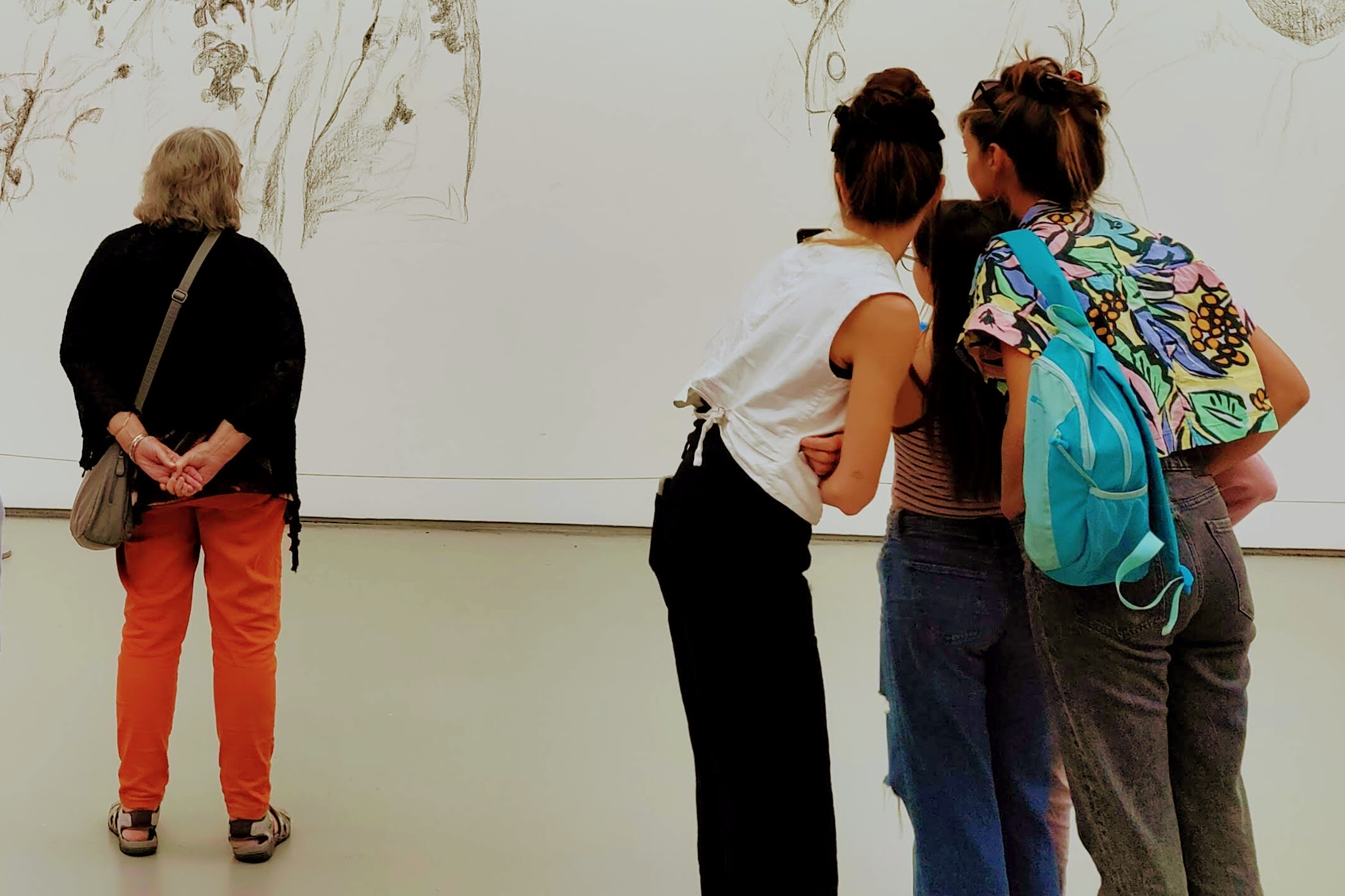
Imagine twenty people standing in front of the same painting. Ask each person to leave the gallery and describe what they saw. Nobody is deliberately giving a false account, yet twenty different paintings emerge. Some remember colour. Some remember faces. Some remember symbolism. Some notice brushwork. Some remember almost nothing except how the painting made them feel. The question isn’t why people disagree; the question is why we expect them not to.
Looking at art is an act of cognition rather than passive observation. Art history therefore offers a remarkable way of studying not only artworks but also the human mind.
Attention, memory and meaning
In the words of cognitive scientist Daniel Willingham, “memory is the residue of thought”. When we’re standing in a gallery looking at a painting, or doing anything else for that matter, there’s a lot fighting for our attention. Attention determines which information receives further cognitive processing, while working memory allows us to hold and work with information temporarily, drawing on what we already know. Because working memory has limited capacity, not everything we encounter receives the same level of processing or becomes equally memorable.
New information becomes more meaningful when it can be connected to knowledge already stored in long-term memory. As we encounter and retrieve knowledge in different contexts, those connections become richer and more readily accessible. What we remember is shaped over time; the more we know, the more we have to connect to new ideas and the more meaningful our interactions with new information are.
Already this changes how we can imagine visiting galleries. Two visitors can stand beside one another while effectively looking at different paintings because they are thinking different thoughts. We don’t simply remember what we look at; we remember what we think about.
Every viewer climbs their own ladder of inference
A painting provides an overwhelming amount of visual information, and nobody processes all of it at the same time, but crucially, the prior knowledge used to process it is different for different people.
Psychologist Chris Argyris developed a mental model describing how we can move from observable data to interpretation, assumptions, beliefs and action, often without consciously noticing the steps in between. His seven-step ‘model ‘Ladder of Inference’ describes how we can select details, assign meaning, form assumptions based on previous experience, build interpretations, and adopt beliefs; which in turn influence what we select from subsequent experience.
When we encounter an artwork, our beliefs will shape the information we select and the interpretations we build. Left unchecked, our certainty can lead to conflict. Argyris shows why it’s important to question our assumptions, something art historians often encourage viewers to do. Using the ladder as a tool for reflection, we can examine our thinking and question how others have reached their own conclusions.
Making perception visible
Artists have always explored ways to guide attention and perception. Selection of subject matter, from a successful hunt to a religious scene, or compositional choices guiding the eye, are decisions made to direct attention. As photography increasingly took over some of the functions of recording appearances, artists could explore other possibilities for painting.
Picasso and Braque’s Cubist investigations asked: can one viewpoint ever capture experience? Their response was to disrupt conventional naturalistic representation, bringing multiple angles and perspectives into a single image. In doing so, Cubism made the act of seeing itself part of the subject of painting. Hockney later reversed the process with his collages. Using photography, the very technology that encouraged realism, he created images built from multiple viewpoints and multiple moments. The result can feel closer to the way memory works than a conventional photograph does. Memory is not a photographic record of experience; it is reconstructed over time.
The gallery as cognitive laboratory
Traditionally, galleries have been understood as places that preserve, research and interpret objects, but from a cognitive perspective, they can also be understood as environments that shape attention, perception, memory and meaning-making.
A scientific laboratory is a controlled environment in which variables are manipulated to observe how systems behave; galleries do something remarkably similar. Curators control the sequence in which works are encountered, the amount of contextual information available, the lighting, spacing, architecture and even opportunities for rest or conversation. None of these decisions changes the artwork itself, but all of them change the conditions under which cognition takes place.
Every exhibition implicitly asks cognitive questions: what visitors will notice first; what comparisons they will naturally make; when explanation will deepen understanding, and when it might narrow interpretation; how much ambiguity to retain. This thinking recasts the curator from an interpreter of objects to a designer of cognitive experiences; their material is not only paintings and sculptures, but attention itself.
Psychologist James Gibson’s ecological approach to perception offers another way of understanding this relationship between viewer and environment. Rather than treating perception as something that happens inside an isolated brain, Gibson emphasised the relationship between an organism and the environment it actively explores. Embodied cognition emphasises that cognition is not independent of the body: movement, bodily orientation and interaction with the physical environment can influence how we perceive and think. In their 1998 paper The Extended Mind, philosophers Andy Clark and David Chalmers challenged the idea that cognition necessarily stops at the boundaries of the brain and body, proposing instead that parts of the external environment can become functionally integrated into cognitive processes.
There are interesting implications for art history here. If perception is embodied, situated and distributed, then meaning cannot reside solely within the artwork; it emerges through an interaction between object, environment and viewer. The gallery becomes an active participant in interpretation rather than a neutral backdrop. That idea also helps reconcile a tension within art history. We often debate whether meaning belongs to the artist, the object or the viewer. Cognitive science suggests a more relational answer: meaning is produced through the encounter. The gallery, then, is not simply a place where meaning is found, but where meaning is continually made.
Meaning happens in the encounter
A familiar claim in art history is that meaning is constructed because people have different cultural backgrounds, ideologies, identities and experiences. My argument is a cognitive one: meaning is constructed because perception involves actively selecting, organising and inferring from limited information. The viewer’s attention determines which features of the painting are encoded into memory, and those encoded features become the raw material from which later interpretations are built.
A large historical painting may contain dozens of figures, gestures, colours, symbols and spatial relationships. No viewer processes all of this. Different viewers notice different things: one notices the dog, one notices the red dress, one notices the dramatic lighting, one notices the expression on a face. This is where Willingham’s point that ‘memory is the residue of thought’ comes into play. If a viewer spends thirty seconds wondering why the dog is included, they are likely to remember the dog; if they spend thirty seconds examining the brushwork, they are likely to remember the brushwork. The remembered painting is already different. A week later, viewers explain ‘what the painting was about’ using the fragments they encoded.
Interpretation is not imposed on a complete perception; it is assembled from a partial, attention-shaped memory. Interpretation does not wait until after perception; it begins within the encounter itself, as attention selects information, prior knowledge shapes what becomes salient, and memory provides material for ongoing interpretation.
Susan Scott’s beach-ball metaphor, where we all encounter a different stripe on a beach ball as our reality, is used to encourage empathy, but in a gallery it is also physically true. Embodied cognition describes how viewers occupy different positions, encounter works in different sequences, attend to different features, and therefore encode different experiences. The body is not a neutral container for perception; distance, angle, movement and duration of looking alter which visual relationships become salient.
The artwork we remember
Art history is not only the study of artworks but also the study of human cognition. Every encounter with an artwork reveals how attention, memory, prior knowledge and embodied experience shape perception. The artwork may remain physically constant, but the experience of it is continually remade by the conditions of the encounter.
Curators shape the conditions that influence attention and memory. A painting displayed alone can reduce competition for attention; hanging two paintings side by side can promote comparison. Providing seating can increase viewing time, and a chronological sequence encourages narrative memory. An exhibition is therefore more than simply a presentation of artworks; it is a designed sequence of attentional cues that shapes what visitors are likely to notice, remember and later describe.
When art historians say that meaning is produced through the interaction between artwork and viewer, the claim can sound abstract, as though interpretation were simply a matter of opinion. Cognitive science suggests something more concrete. A painting contains more information than any viewer can process. Attention selects some features and ignores others; the selected features are encoded into memory; later interpretations are built from those remembered fragments. Twenty visitors leaving the same gallery are therefore not merely offering different opinions about a shared experience; they have undergone, and are recalling, different cognitive experiences. This does not mean that every interpretation is equally valid, or that the artwork has no material existence beyond the viewer’s response. It means that the experience of that artwork is produced through an encounter between object and viewer. The artwork does not arrive in the mind as a complete package waiting to be interpreted; it is gradually assembled through attention, movement, memory and inference.
Selected Bibliography
Clark, Andy. and Chalmers, David. 1998. ‘The extended mind’. analysis, 58(1), pp.7-19.
Scott, Susan. 2011. Fierce Conversations: Achieving Success in Work and in Life, One Conversation at a Time. (United Kingdom: Little, Brown Book Group)
Turner, Emma., Goodwin, David. and Caviglioli, Oliver. 2022. Annie Murphy Paul’s The Extended Mind in Action. (United Kingdom, Hachette Learning)
Willingham, Daniel T. 2021. Why Don’t Students Like School? A Cognitive Scientist Answers Questions About How the Mind Works and What It Means for the Classroom. (United Kingdom, Wiley)ory paragraph for this Field Note.