
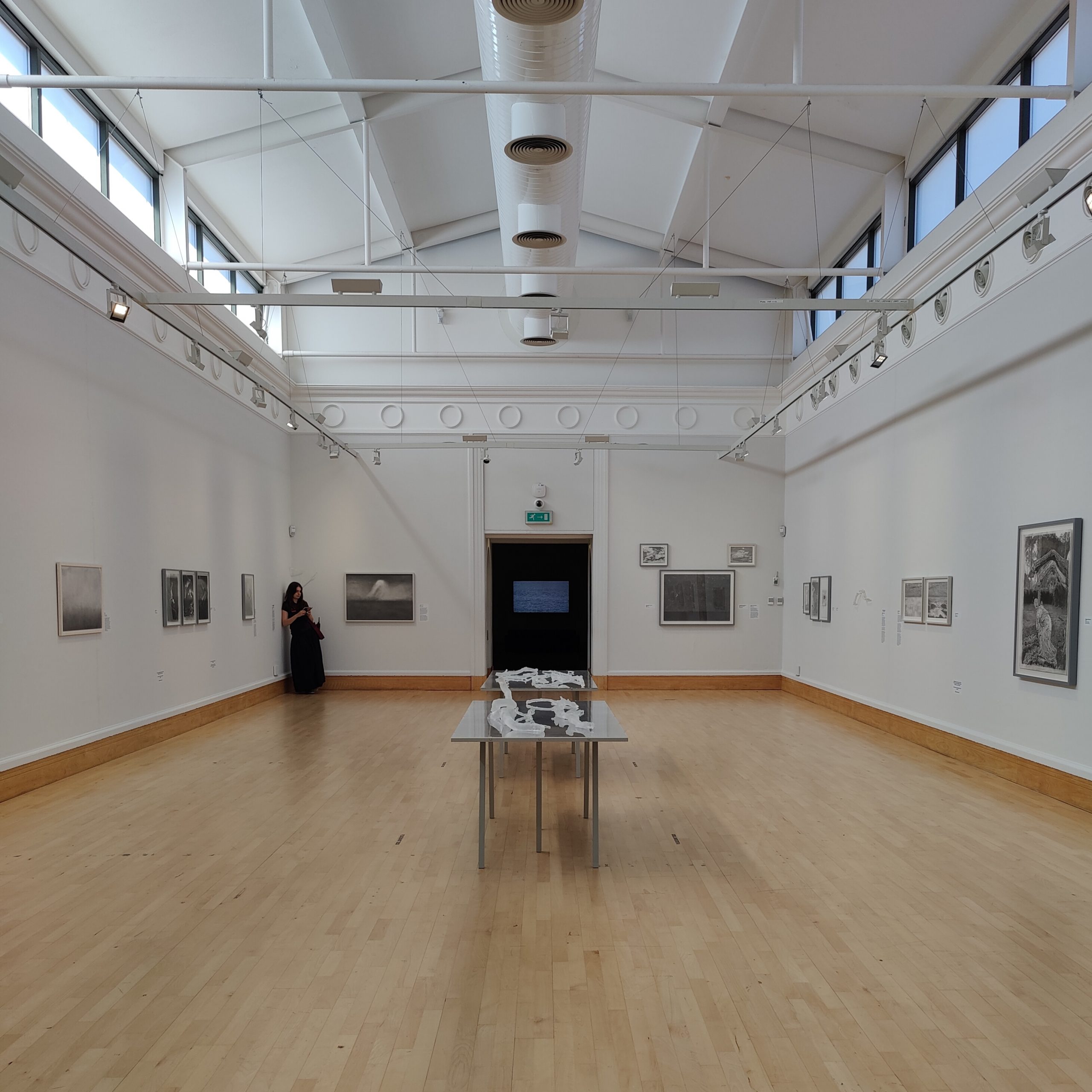
Some exhibitions ask you to look. Drawn Through Time asks you to slow down.
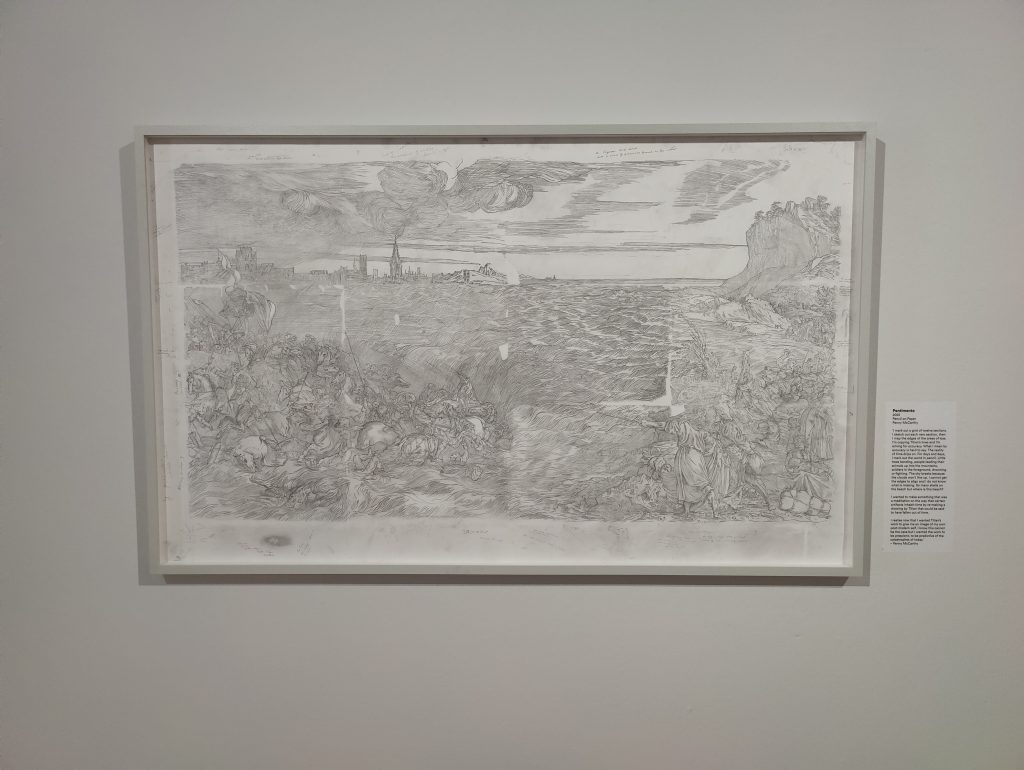
At the heart of the exhibition is Penny McCarthy’s relationship with Titian’s monumental woodcut The Submersion of Pharaoh’s Army in the Red Sea (c.1549). After spending months studying the rarely displayed print in museum storage, McCarthy produced a series of drawings that aren’t copies so much as conversations. Looking slowly became making; observation became a way of travelling through time; an idea that quietly underpins the whole exhibition.
Drawing is often thought of as preparation for something else; a sketch before the “real” artwork begins, but Drawn Through Time argues the opposite. Here, drawing is research, record, memory and reflection. It is a way of seeing what has been lost, of filling gaps, of changing meanings. Even erasure becomes part of the conversation.
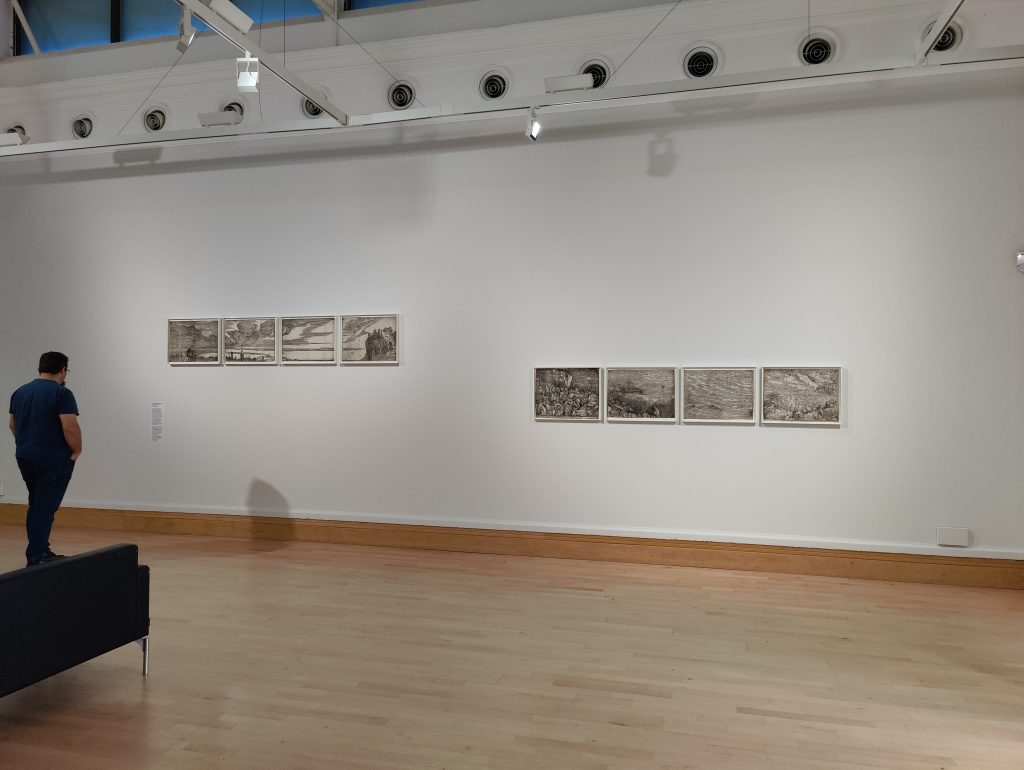
McCarthy’s engagement with Titian fascinated me. His original design was translated into multiple woodblocks before being printed and displayed together in individual frames (fig.1), whereas her redrawing reunites the image into a single act of mark-making (fig.2). Looking closely, I was struck by the simplicity of some of the marks alongside the extraordinary complexity of the whole. At moments I found echoes of Cy Twombly’s energetic line and even Chris Ofili’s repetitive, meditative drawings. These weren’t direct comparisons so much as reminders that artists continue to speak to one another across centuries.
The invited artists extend this conversation in different directions. Emma Kay’s drawings from memory, including the Bible and a map of the world, expose the unreliability of what we think we know. Billy Hughes shifts between found photographs and AI-generated futures, while Marissa Textor, George Shaw, James Pyman and Fleur Patrick each explore different relationships between memory, place and existing images. Some draw from real landscapes, others imagined ones, but throughout the exhibition there is a sense that drawing itself is a journey; a survey of where we’ve been and how we remember it.
Even the way the exhibition was installed made me think. Works were hung at different heights, inviting changing relationships between viewer and artwork, and subtly recalling the scale of Titian’s original print. Who is looking? From where? At what distance? Those curatorial questions felt just as important as the drawings themselves.
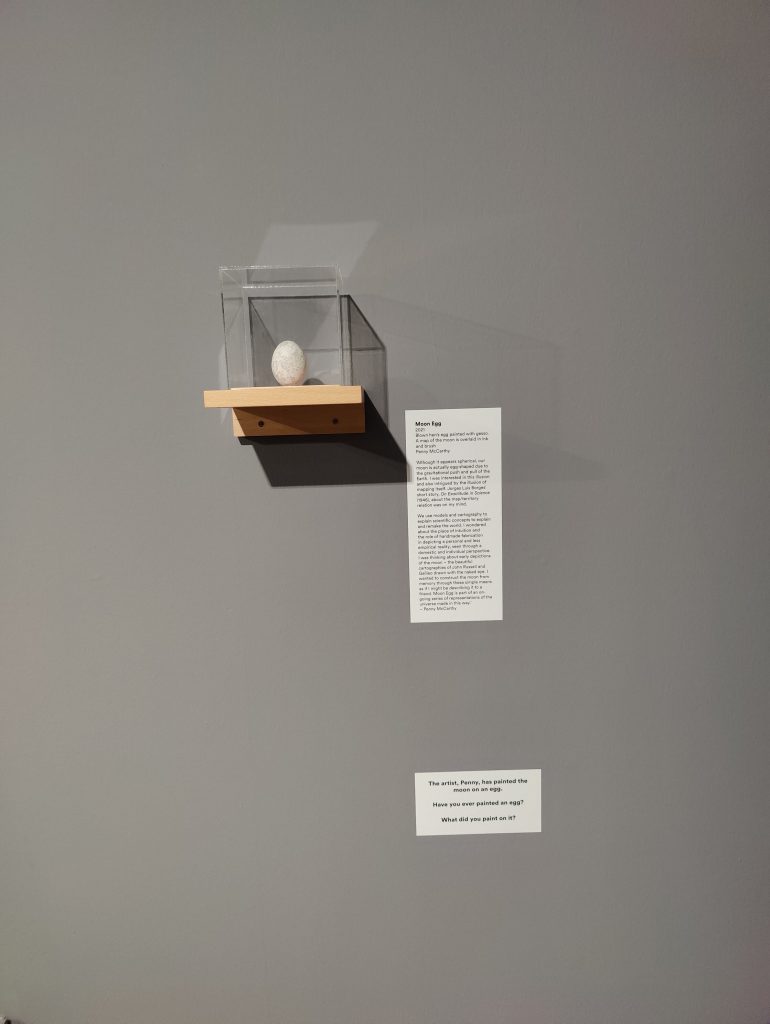
One small (and longstanding for me) frustration came from the interpretation aimed at children, where prompts and questions are displayed on walls, low to the floor. Lakeside Arts has used this approach successfully before, but I continue to wonder whether some of the questions miss an opportunity. Rather than encouraging children to investigate why an artist has made a particular choice, they often redirect attention back to the child’s own experience. Asking “Have you ever painted an egg?” after seeing McCarthy’s egg painted as the moon (fig.3 feels less engaging than asking why the artist chose an egg in the first place, or inviting children to invent their own symbolic object. Curiosity about art begins with looking closely, and children are more than capable of doing that.
One of my favourite moments came not from the artworks themselves but from another visitor. A young boy sat in the gallery looking at manga on his phone while surrounded by drawings rooted in centuries of artistic tradition. Rather than feeling jarring, it somehow felt completely appropriate. Comics, woodcuts, graphite drawings, AI-generated images—they all belong to the same long history of people trying to record stories, places and ideas through marks on a surface. Time travel, after all, isn’t just about looking backwards.
I was especially pleased to revisit Drawn Through Time after initially seeing it with the ChalleNGe SEND Galleries Group. Given more time, the exhibition revealed itself much more fully. As someone naturally drawn to graphite, paper and printmaking, I found the aesthetic deeply satisfying, but it was the ideas that lingered. This is a thoughtful exhibition about observation, memory and the quiet act of drawing as a way of understanding both art history and ourselves. More than anything, it reminded me that sometimes the most radical thing an exhibition can ask us to do is simply spend time looking.
Exhibitions like this bring nuanced, intelligent contemporary art to Nottingham while remaining accessible to a wide audience. They invite us to think rather than simply consume; in a world that rarely encourages us to slow down, that feels welcome.
Exhibition details
Drawn Through Time
Venue Djanogly Gallery, Lakeside Arts, Nottingham
Dates 9th May – 26th July 2026
Artists Penny McCarthy, Titian and Other Time Travellers
Website https://www.lakesidearts.org.uk/exhibition/drawn-through-time/
Image References
- Drawn Through Time – Djanogly Gallery, Nottingham. Photograph by the author, July 2026
- Titian, The Submersion of Pharaoh’s Army in the Red Sea, c.1549. Woodblock print. Displayed in Djanogly Gallery, Nottingham. Photograph by the author, July 2026
- Penny McCarthy, Pentimento, 2025. Pencil on paper. Displayed in Djanogly Gallery, Nottingham. Photograph by the author, July 2026
- Penny McCarthy, Moon Egg, 2021. Blown hen's egg painted with gesso. A map of the moon is overlaid in ink and brush. Displayed in Djanogly Gallery, Nottingham. Photograph by the author, July 2026