

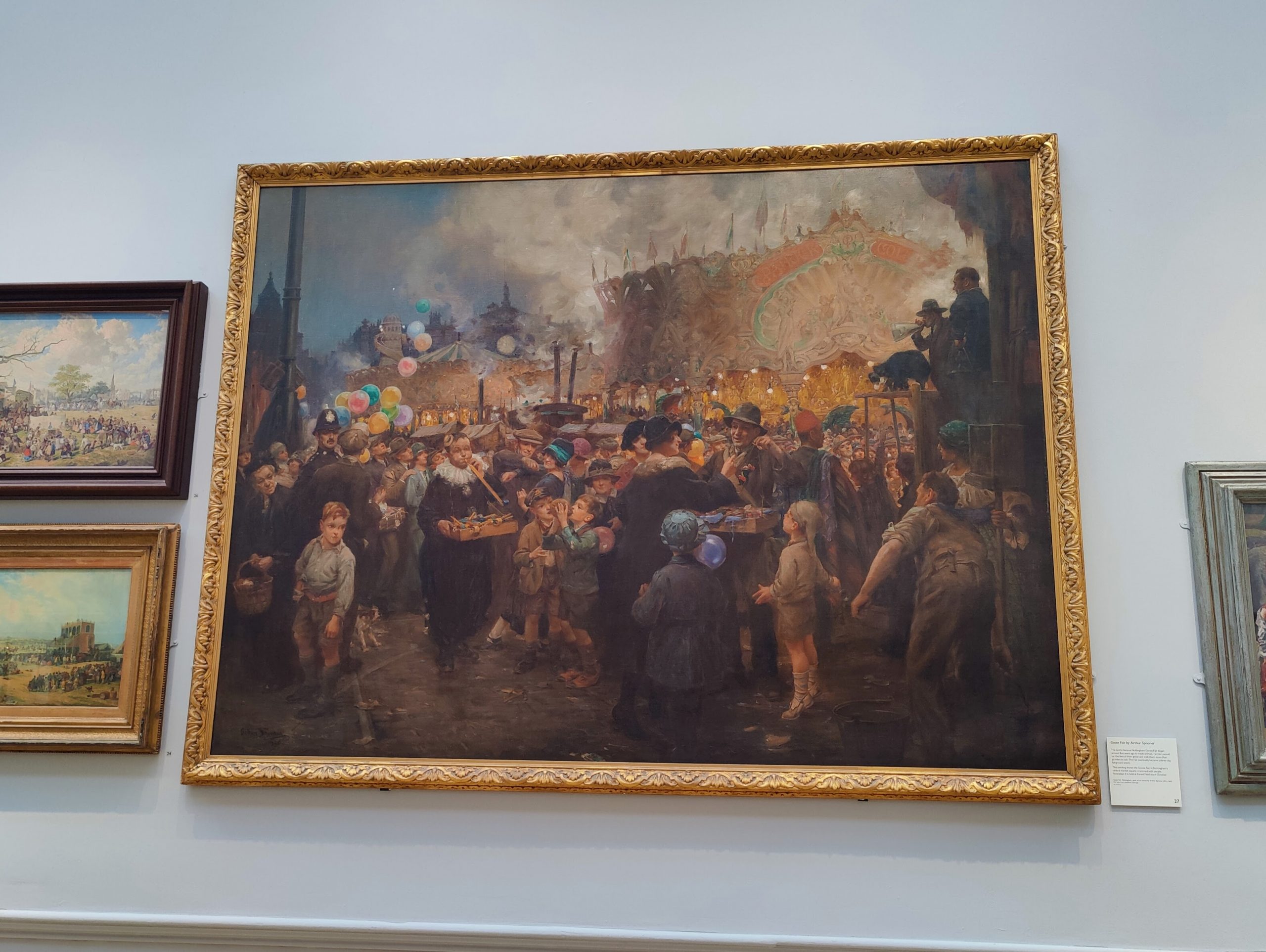
Arthur Spooner’s The Goose Fair, Nottingham (1926) is a favourite in Nottingham Castle’s Long Gallery. Dense with light and movement, it captures a post-war moment of social and cultural change that remains recognisable to Nottingham audiences today. Combining interwar social observation with the traditions of costumbrismo, Spooner transforms Goose Fair into a modern urban display in which clothing, gesture and public ritual render Nottingham society visible to itself.
The Making of a Modern Tradition
Nottingham’s Goose Fair originated as a Michaelmas trade fair and has been held in the city for over 700 years. Named after the thousands of geese that would be walked to Nottingham from as far as East Anglia, the event became an annual celebration. Over the years it expanded to include travelling sideshows and fairground attractions, eventually growing into the twenty-acre event of more than 500 rides that visitors know today. Spooner’s painting depicts the historic Goose Fair while it was still held in Nottingham’s Great Market Place (Old Market Square), on the cusp of its move to a new site on Forest Recreation Ground in 1928. Read through the lens of costumbrismo, a tradition concerned with the depiction of everyday customs and social types, the painting becomes more than a record of a popular fair.
A Crowded Composition
The first thing that stands out is the compression of space. Spooner packs the foreground with figures, attractions, vendors, balloons and animals. There is no obvious resting point for the eye. Instead, the viewer is pulled through a crowded network of visual incidents. The composition works clusters of people around illuminated attractions; fairground structures rise above the crowd, creating vertical accents that prevent the scene from becoming flat. In the distance, Nottingham’s Exchange Building, demolished in 1926, the year of the painting, emerges through pockets of steam. This crowded arrangement mirrors the sensory overload of a fairground and Spooner places the spectator within the crowd itself, transforming the viewer from observer into participant.
The painting is a showcase of artificial light at dusk. Spooner contrasts deep blues, browns and greys of evening with warm yellows and oranges from fairground lamps: patches of reflected light on faces, clothing and steam. Despite these seemingly natural tones, Spooner punctuates the painting with pockets of artificial colour: a cluster of vividly coloured balloons, a handful escaping the crowded scene and drawing the eye towards the open sky, their pigments echoed across the image in the trims of clothing and traders’ wares. This creates a strong emotional effect: the fair becomes a temporary world of enchantment within the ordinary city.
Spooner’s painterly approach establishes a strong sense of movement and energy as crowds appear to surge and flow across the canvas. Newer electrically illuminated attractions contrast with older steam-driven rides, while drifting clouds of steam unify the composition. The fair becomes a theatre of fleeting narratives in which no single subject dominates. Yet this apparent coherence is sustained through a series of tensions: between tradition and modernity, social mixing and hierarchy, individuality and crowd.
Ancient ritual amid mechanised urban life
Goose Fair presents Nottingham at a moment when older communal traditions coexist with modern technologies and social change, both locally and globally. Spooner frames the fair as a medieval survival entering the twentieth century. The livestock market that once marked the end of the harvest had long since been overtaken by sideshows and showmen; traditional fairground attractions now sit alongside mechanised spectacle. Steam-powered rides and electric illumination signal a culture in transition, where longstanding customs persist by adapting to modern forms of entertainment.
Throughout the painting, Spooner documents material traces of change. The architecture of Market Square anchors the scene in a familiar civic landscape, projecting a sense of post-war continuity. Yet much of this built environment was itself approaching transformation, positioning Goose Fair as a record of a city on the cusp of change. In the lower left, tramlines cut across the cobbled square, a narrow gap in the crowd drawing the viewer’s eye. These tracks provide another marker of transition. By 1926 Nottingham’s tram system was already in decline, and within a decade it had disappeared entirely in favour of trolleybuses. What appears to be a permanent feature of the urban landscape is revealed, with hindsight, to be fleeting.
Read in this way, Goose Fair becomes more than a depiction of a popular annual event. It is a snapshot of a society negotiating continuity and change, preserving within a single crowded image technologies, spaces and traditions that were already beginning to disappear. Rather than offering a nostalgic celebration of the past or an uncritical embrace of modernity, the painting adopts an observational, perhaps ethnographic gaze.
Reading the Crowd
Spooner’s costumbrista interest in social types is especially evident in his construction of the crowd. At first glance, the composition appears chaotic, yet visual markers organise society into recognisable categories; rather than individual portraiture, Spooner builds Goose Fair around socially legible urban “types”. The fair collapses social distance without erasing social distinction, bringing together different ages, occupations, classes and cultures within a single civic space.
Clothing, and particularly headwear, acts as a system of social classification through which the apparent disorder becomes intelligible: a police helmet signifies authority; flat caps suggest working-class masculinity; cloche hats signal feminine respectability. Performers are distinguished by costume, while traders are identified through headscarves and rolled shirt sleeves. The crowd is therefore read less as a collection of individuals than as a catalogue of social roles.
Spooner further creates a hierarchy of visibility as the viewer moves through the composition: certain figures emerge almost as characters. A policeman stands apart in his structured uniform, a block of dark colour amid the bright balloons and fabrics surrounding him, suggesting that the fair’s bustle remains subject to observation and control. Nearby, a clown’s exaggerated lace collar and tray of colourful blowers mark him as a representative of the entertainers who animate the scene. Elsewhere, a young couple jostle through the crowd and a child rises onto tiptoes to glimpse a stallholder’s wares.
Like nineteenth-century costumbrista painters, Spooner records a local culture whose permanence already feels uncertain. The painting hangs between documentation and romanticisation, preserving a particular moment while subtly shaping it into spectacle. Everyone is simultaneously spectator and performer: participating in the action of the fair while also standing in for the broader society of 1920s Nottingham.
Fragmented Narratives
Despite the density of the composition, there is no central protagonist. Spooner offers dozens of implied stories but refuses to privilege any one of them, leaving the viewer to construct their own narrative. This openness may account for much of the painting’s enduring appeal. It rewards repeated looking, each viewing uncovering new details, encounters and possibilities.
Viewers are free to connect characters and invent relationships. Is the child facing away from the policeman simply navigating the crowd, or attempting something more mischievous? Is the woman at the centre being restrained or guided? Does the child seen from behind in the foreground serve as a proxy for the viewer, drawing us into the scene? Is the clown, perhaps even a disguised self-portrait of Spooner, narrating the spectacle? Perhaps the story is not human at all but belongs to the animals that weave through the composition, interrupting movement and competing for attention. The painting offers no definitive answers, and it is precisely this ambiguity that keeps its narratives alive.
In this sense, Goose Fair balances the individual and the collective. No single figure dominates, yet countless small dramas emerge from the crowd. Spooner presents the fair as a theatre of fleeting narratives in which every participant is both anonymous and significant. Rooted in the particularity of Nottingham’s Goose Fair, the painting preserves a specific place and moment while capturing something more universal: the experience of losing oneself in a crowd and finding stories there.
What Remains
A century after its completion, The Goose Fair, Nottingham functions as more than a record of a popular event. Many of the details Spooner observed have disappeared: the Exchange Building has been demolished, the tramlines removed (and returned), and the fair itself relocated from Market Square. Yet the painting preserves these elements within a shared visual memory of the city.
This preservation extends beyond buildings and technologies. Spooner records ways of dressing, social customs, forms of entertainment and patterns of public interaction that might otherwise be forgotten. In doing so, he records not simply what Nottingham looked like in 1926, but the experience of moving through it.
The enduring popularity of Goose Fair lies partly in this dual function. It is both a historical document and a work of imagination: a painting that records a specific place and time while continuing to invite new viewers to enter the crowd, follow its stories, and recognise something of their own city within it.
Selected references
https://www.visit-nottinghamshire.co.uk/blog/read/2024/08/the-fantastic-history-of-goose-fair-b5961
https://artuk.org/discover/artworks/the-goose-fair-nottingham-46818
https://en.wikipedia.org/wiki/Nottingham_Corporation_Tramways