

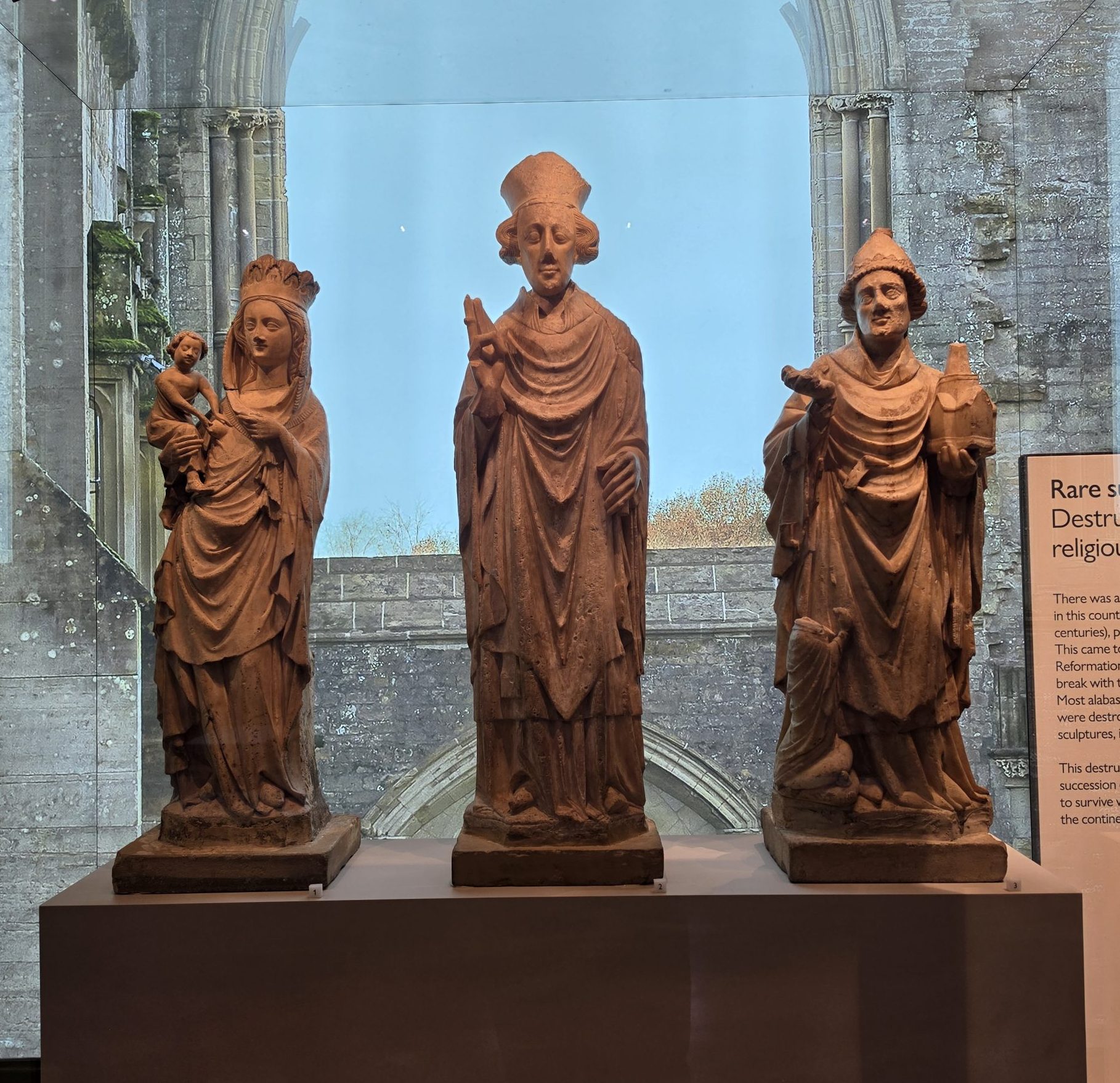
In 1779, three medieval, alabaster sculptures were found buried beneath the floor of a demolished church at Flawford, south of Nottingham. These unassuming figures offer a window into a thriving international artistic trade and English visual culture that has largely disappeared.
Late-medieval English churches were filled with images and colour, yet when we visit these churches today, we encounter very little of that world. This is largely due to the Reformation and the iconoclastic destruction and dispersal of Catholic images, sculptures, books and symbols that didn’t just change religious belief, it changed the visual environment of England.
Twentieth-century excavations of the site occupied by Flawford Church, between the villages of Ruddington, Plumtree, Edwalton and Bradmore, revealed a history stretching back to the mid Bronze Age. Whilst it is unclear if there was ever a settlement on the site, a small stone Saxon church is thought to have been established in the early ninth century and was subsequently enlarged and remodelled through a series of phases. Although the medieval church was later abandoned and demolished, the archaeological remains provide a detailed picture of a church that developed over several centuries and played an important part in the religious history of the local community.
Nottingham was a major centre for carving, painting and gilding alabaster in the fourteenth and fifteenth-centuries, and examples were exported extensively, but their survival in England is exceptionally poor. Consequently, the Flawford alabasters become clues to a missing artistic history: polychrome sculpture, altarpieces, images of saints, devotional objects, colour, gold and narratives.
Surviving English artworks across continental Europe can help us imagine a church that no longer exists. Seeing an English alabaster still in the church for which it was acquired, somewhere in France or Spain, is a version of something that could have been encountered before the Reformation. The context is different and its history has changed, but almost like a time capsule, it preserves aspects of the visual culture largely dismantled across England.
More than objects
It is assumed that the three Flawford alabasters were hidden under the chancel floor to prevent their destruction. We will never know what the church at Flawford looked like, but the survival of English examples abroad gives us access to evidence of scale, colour, iconography and ways in which sculpture was displayed. Types of devotional imagery and the relationship between sculpture and architecture offer an impression of the kinds of objects English churches could contain.
The Flawford alabasters are emblematic of the wider artistic and material culture disrupted by the English Reformation. The familiar narrative of Henry VIII’s break with Rome followed by the development of Protestantism and the simplification of churches, can make this process appear primarily theological. Eamon Duffy instead emphasises the extent to which late medieval religion was embedded in a shared material and spiritual culture. He argues that there was a “remarkable degree of religious and imaginative homogeneity across the social spectrum”, sustained through a common “repertoire of symbols, prayers, and beliefs.” Objects such as the Flawford figures were not originally isolated ‘artworks’ in the modern museum sense: they belonged to a wider religious environment in which images, liturgy, saints, votive practices and communal memory were interconnected. As Duffy notes, the laity used “inherited ritual” to express “their experience of community” and their place within it, while the liturgy provided the stories and symbols through which medieval people understood their place in the world.
The fate of the Flawford alabasters illustrates what was lost through Reformation iconoclasm: not simply individual objects, but aspects of a whole system of religious and communal meaning. Their concealment beneath the chancel floor suggests that parishioners understood the figures as objects worth protecting even as the religious environment that had given them meaning was being dismantled. Duffy describes the Reformation as a “violent disruption” of late medieval religious practice, in which the removal of images, altars and objects associated with the dead was “an act of oblivion” that broke the continuity between generations. The destruction and removal of material objects transformed more than the appearance of churches; it altered the relationship between communities, their saints, their dead and their own collective past. Seen in this context, the Flawford alabasters provide a particularly tangible example of Duffy’s broader argument: the English Reformation was not simply a theological transition from Catholicism to Protestantism, but a profound destruction and transformation of an established material and visual religious culture.
Seeing what survived
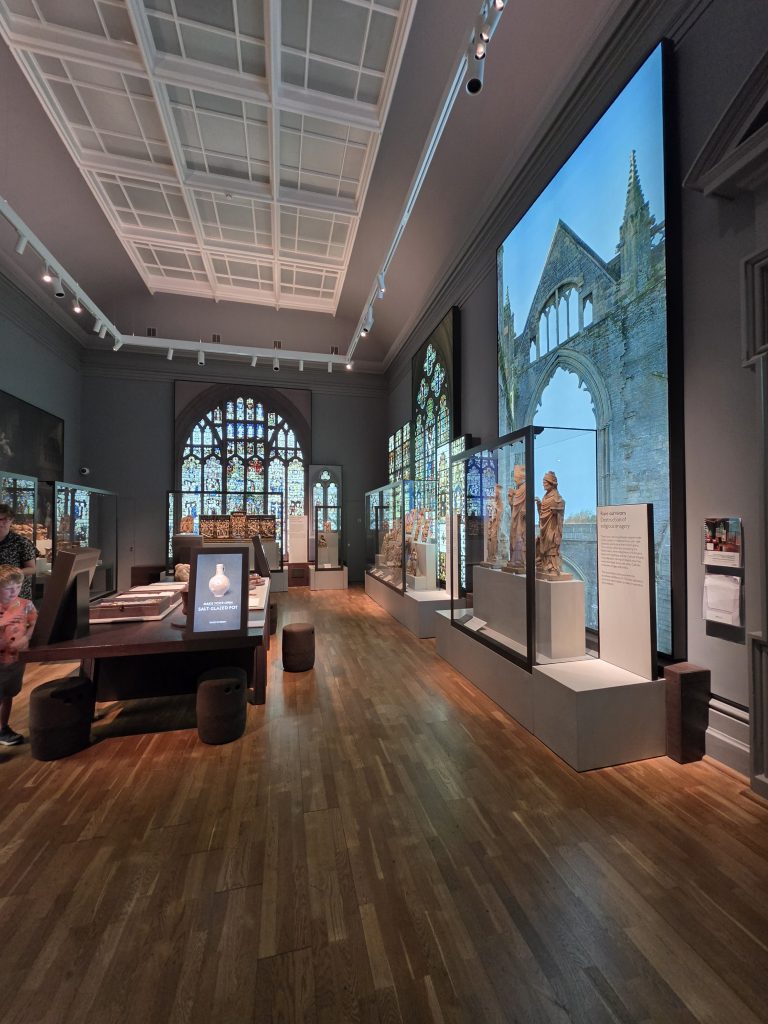
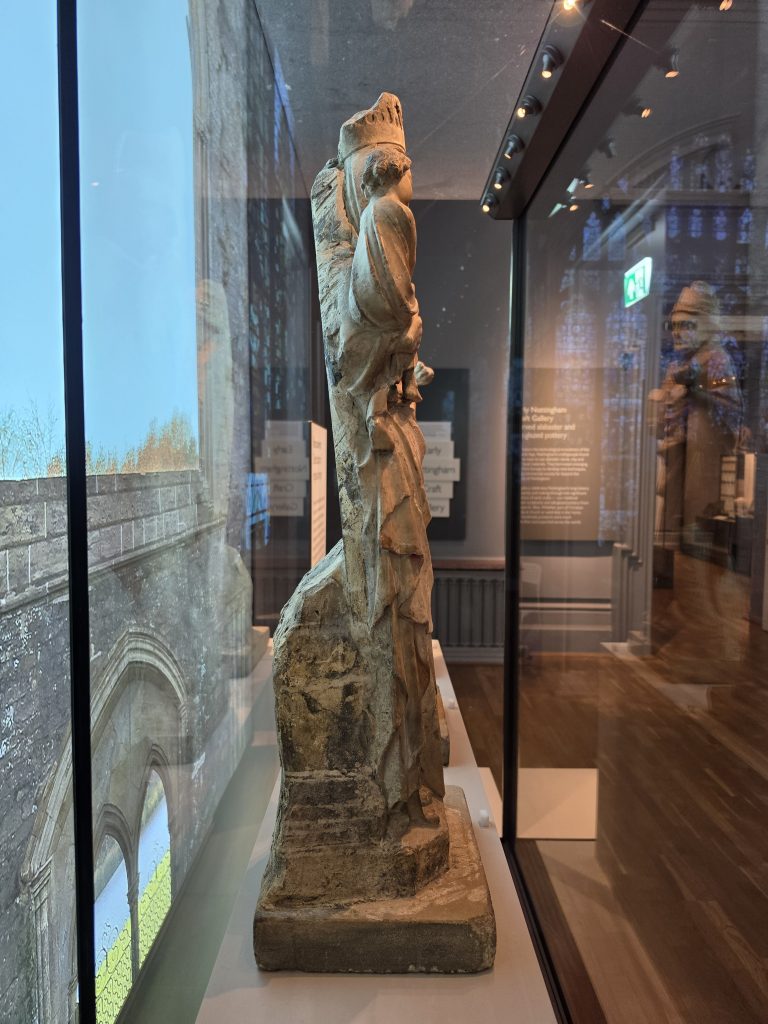
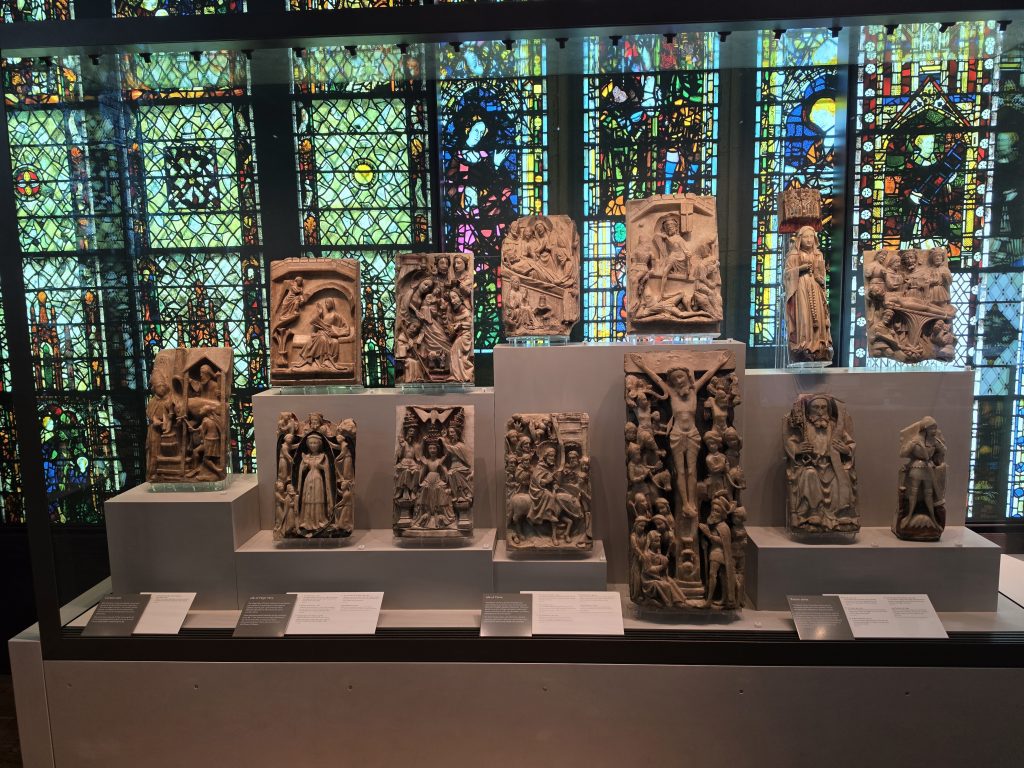
The three alabasters are currently on display at Nottingham Castle, in the Early Nottingham Craft Gallery alongside other examples of English alabaster and glazed salt pottery. In addition to the objects on display are interactive stations to explore the processes used to make them; with so much drawing the attention of visitors, it’s actually easy to overlook the alabasters. The three figures are displayed together, although there is no suggestion that this reflects their original arrangement. The Bishop occupies the centre and is tallest, while the Virgin and St Peter are of comparable height. Their common bases, broadly similar treatment of drapery and related scale suggest that they belong to a coherent group, even as their poses and faces distinguish them from one another. Their flat backs are a reminder that these were not conceived as freestanding sculptures. They were made to be seen within a setting, probably against or within a niche.
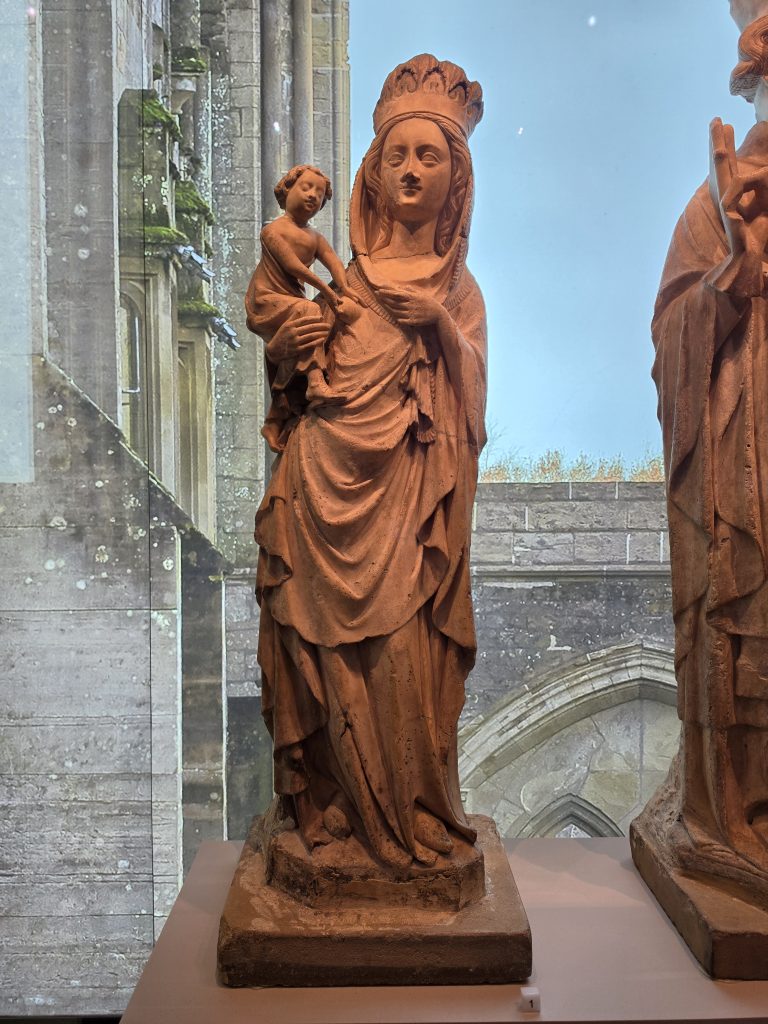
The Virgin stands, weight shifted, child on hip; her body behaving like a body. The child’s feet grip his mother’s side, while his hand touches her clothing and breast. The sculpture presents a surprisingly intimate physical relationship between mother and child and isn’t simply a study of iconography but represents an embodied human relationship.
Her clothing is built up through multiple layers and folds, with particular attention to the edges of the fabric and the transition between the head covering and the garment beneath. The drapery describes the body beneath it and responds to the movement of the figure. The sculpture demonstrates a sophisticated understanding of how a three-dimensional material can represent weight, fabric, movement and the human body, revealing that English sculpture wasn’t just producing formulaic religious images; there was observation, modelling and visual invention.
The figures are a fairly uniform bright grey. The alabaster is not completely dull, but its translucency isn’t particularly apparent. We know the figures were originally richly decorated, and surviving traces of red and gilding indicate that their visual appearance was radically different. Other alabasters in the gallery preserve more obvious traces of colour and gilding, making it easier to imagine the Flawford figures not as pale stone sculptures but as brightly coloured images.
The Virgin’s head has clearly been removed, with evidence of later repair around the neck and head covering; there is also a break across her waist. St Peter and the Bishop have similarly suffered losses which are less apparent. The Bishop is represented in a frontal, symmetrical position, right hand raised in a blessing gesture with a ring and remnants of a staff. His downward gaze suggests that he may have been placed in an elevated position. Layers of vestment are identifiable; a stole and maniple show that the sculptor was communicating the ecclesiastical status and ritual identity of the figure. St Peter, in turn, is presented as Pope, wearing a three-tiered tiara, his head is turned to a figure at his feet. He holds familiar attributions of keys and a church in his gloved hands whilst he is shown performing a blessing gesture, despite missing fingers.
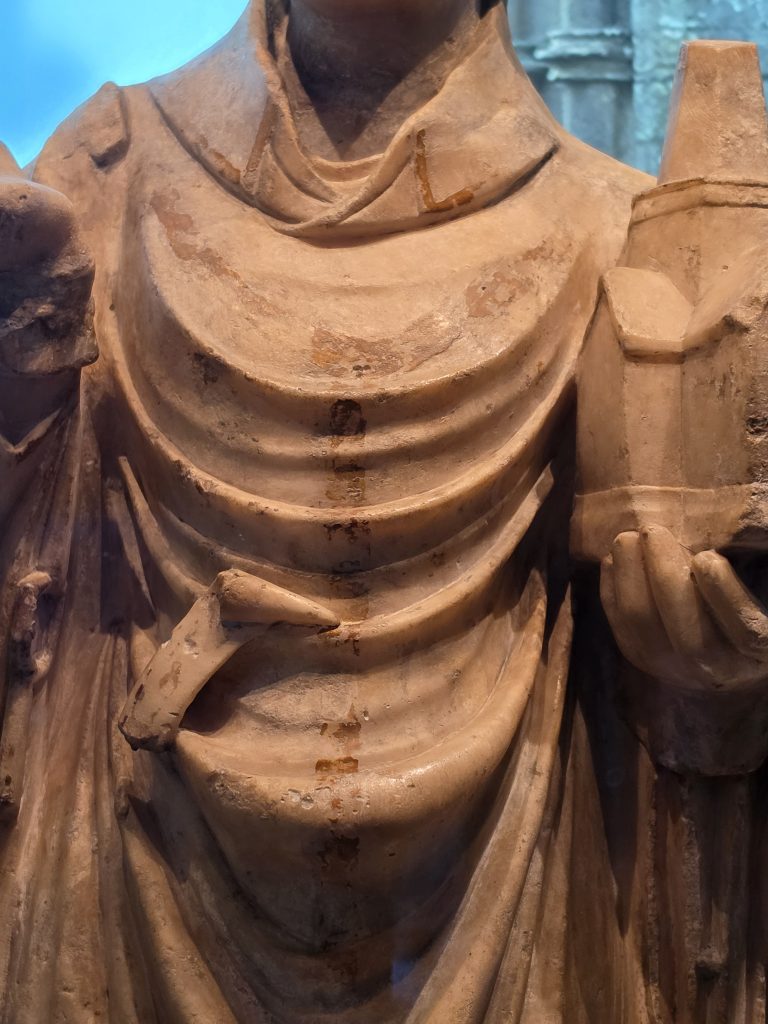
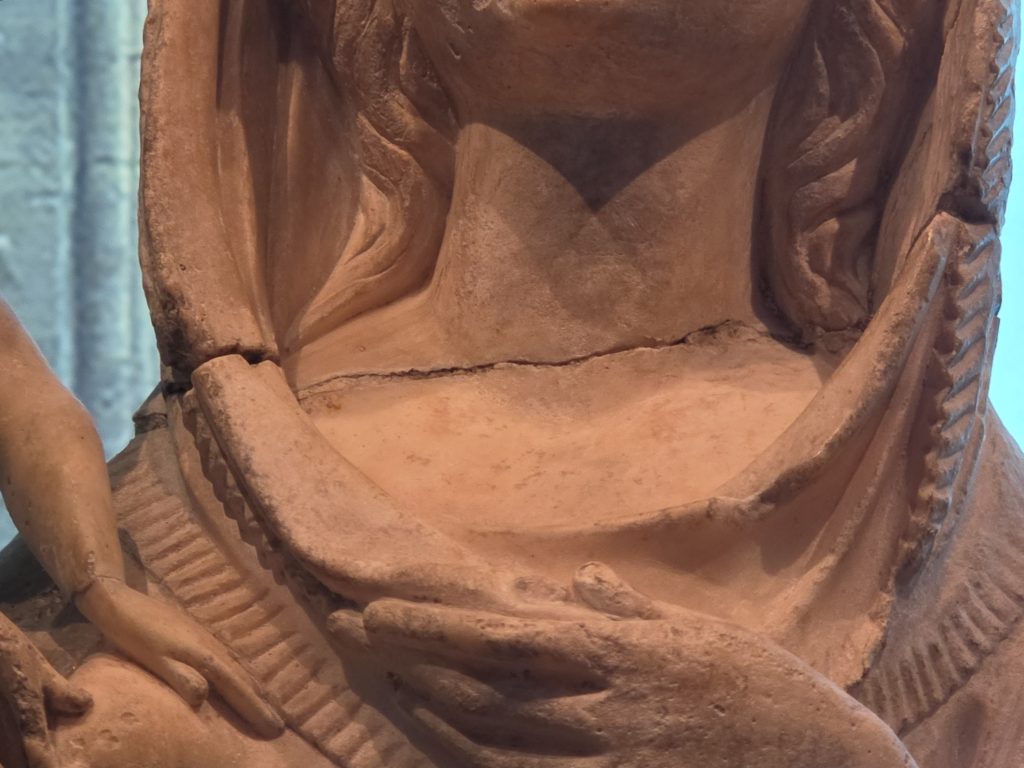
Their surviving faces, gestures and carved details provide evidence of the sophistication of medieval English sculpture; their repairs, losses and altered surfaces show us how much of that original visual experience has been transformed or lost. We should be cautious of treating every mark of damage as evidence of Reformation iconoclasm however they act as a reminder that the museum object is visually incomplete even when it is physically present. Subsequent history has stripped the alabasters further: pigment was lost, surfaces altered, contexts disappeared, and the surviving sculptures were eventually reclassified as art historical objects.
Lives after the Reformation
Alexandra Walsham argues that objects of the Reformation weren’t simply destroyed or preserved in a binary way: they could be concealed, repurposed, adapted and recycled, and in doing so they continued to carry memories of their Catholic past. She explains how the reformers sought to discredit assumptions and reduce “hallowed objects…from precious treasures to worthless rubbish”, in a process that involved not only destruction, but recontextualisation. Symbols of Christianity were often literally re-formed; books, vestments, stone, timber, lead and silverware have survived because they “successfully negotiated the transition to Protestant worship”. The Flawford alabasters have had several lives: medieval devotional images, objects threatened by religious change, hidden and buried, rediscovered, used as garden ornaments, and now museum objects. The figures therefore aren’t merely ‘survivors of the Reformation’; they are objects with an afterlife shaped by the Reformation.
The range of objects on display in the gallery makes it clear that ‘Nottingham alabaster’ does not describe a single visual style or level of finish but a productive artistic culture capable of variation. The Flawford figures demonstrate considerable attention to the human body, drapery and gesture, while other surviving examples employ different degrees of detail and finish. They also represent medieval English art, not as it was, but as it is. We will never know exactly how the artistic environment of pre-Reformation England appeared, nor will we know how English artistic practices would have developed had it not happened, but what we do have are objects that retain the memory of what they were, and evidence of their historical encounters.
How much of our idea of medieval English art has been shaped by what happened to survive?
The alabasters are an unusually good case study because we have this bizarre situation where the production was English with a market that was international. The objects survived disproportionately abroad and the surviving English examples are fragments of a much larger tradition that we can still encounter.
The site where Flawford Church once stood is now a field at a crossroad that is no longer a crossroad. All that remains are a handful of eighteenth-century gravestones and a plaque marking the location of the church. The twentieth-century stone outlines that once marked the floorplan of the building are now only visible as cropmarks. The church was already falling into decay before the Reformation as the surrounding villages grew and their own churches were built; parishioners at Ruddington continued to make the journey to Flawford to bury their dead, stopping mid-way to rest their coffins, but their visual world was changed.
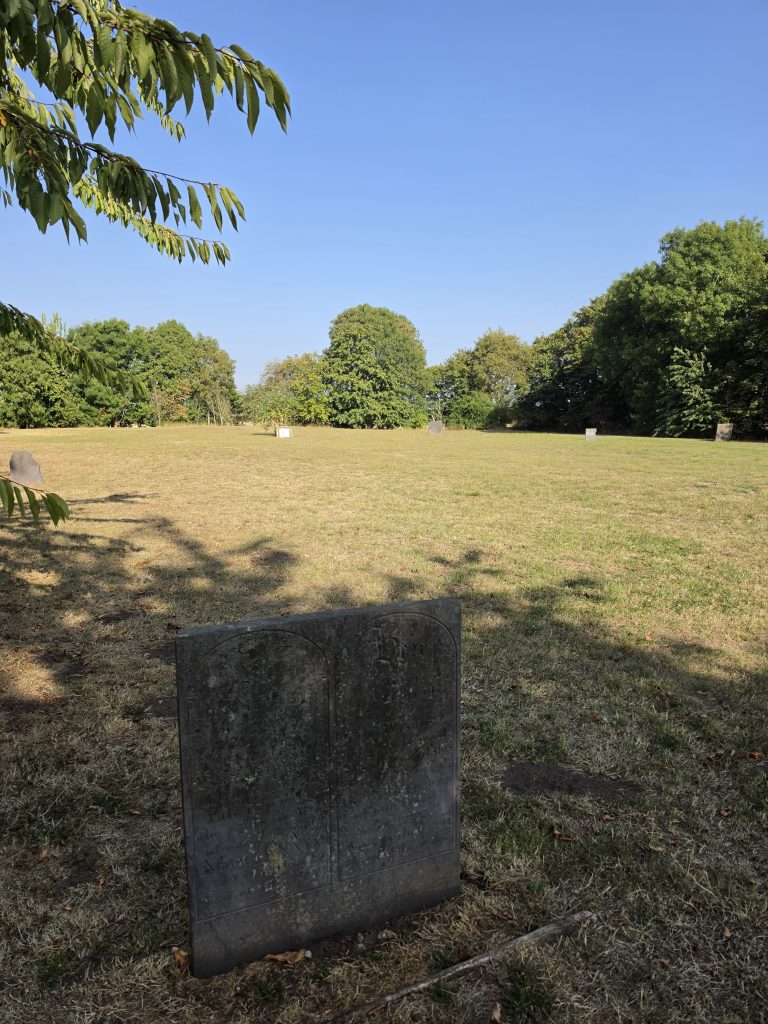
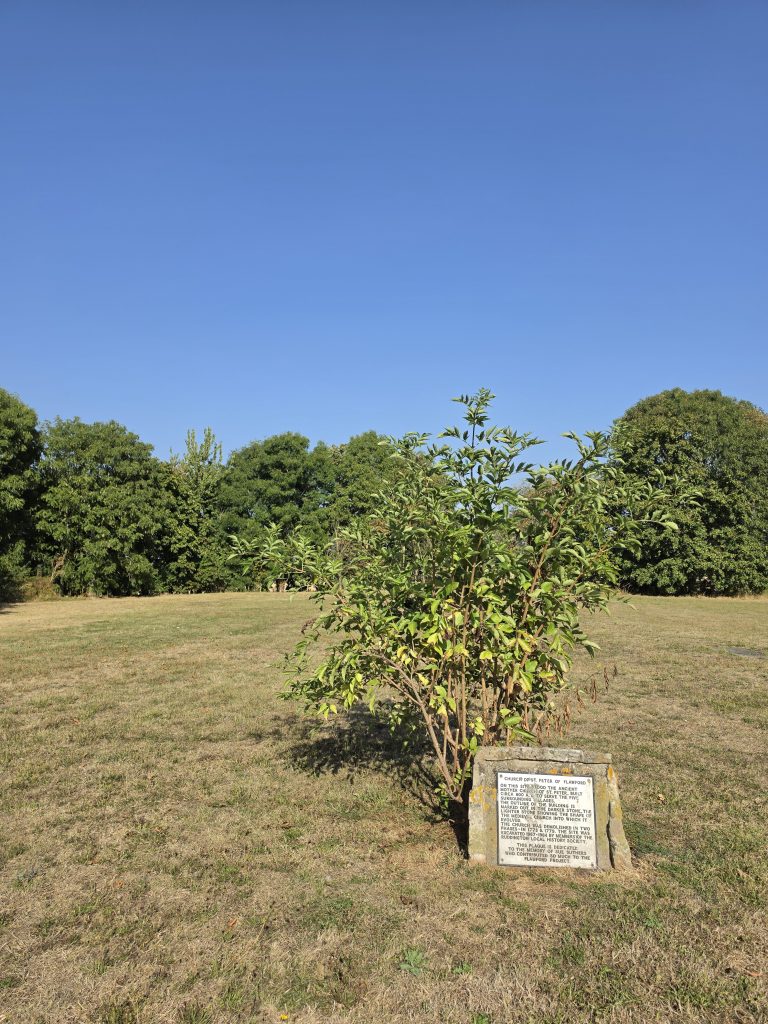

The surviving alabasters complicate the idea that English art history begins again after the Reformation. The very existence of the Flawford figures gives significance to a church that would probably only retain local memory, instead, they make it part of a broader artistic record. The presence of Nottingham alabasters abroad offers an unexpected way into the lost visual culture of pre-Reformation England; their absence from most British churches is itself evidence of the enormous transformation brought about by the Reformation. The Flawford figures, meanwhile, provide a rare local survival whose fragmented biography, from devotional image to hidden object to museum specimen, allows us to consider not only what medieval English churches contained, but what happens to artworks when the world that gave them meaning disappears.
These are Nottingham sculptures, but almost everything around them has disappeared. The church they came from has disappeared, their original colour has largely disappeared, their original context has disappeared, and the religious world for which they were made has disappeared. And yet the objects remain.
Selected Bibliography
https://southwellchurches.nottingham.ac.uk/flawford/hintro.php
http://flawford.org.uk/index.htm
Duffy, Eamon. 1992. ‘The stripping of the altars: Traditional religion in England.’ (New Haven).
Ferguson, George. 1959. ‘Signs & symbols in Christian art.’ (New York: Oxford University Press).
Walsham, Alexandra. 2017 “Recycling the sacred: material culture and cultural memory after the English Reformation.” Church History vol 86. no 4 pp. 1121-1154.