

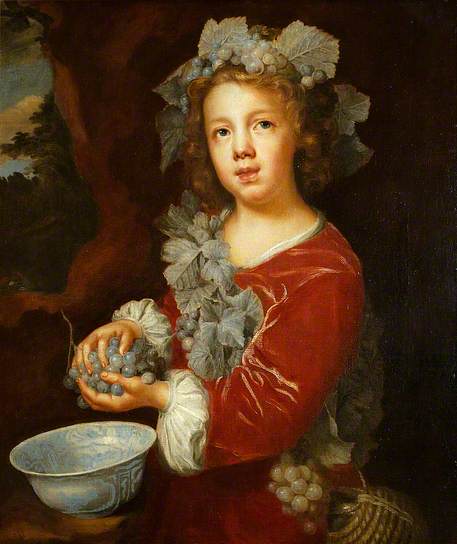
The painting depicts Beale’s young son, Bartholomew, in the guise of the Roman god, Baccus, showcasing her ability to combine mythological allegory with tender realism, and a glimpse into her personal life.
Reading the Work
Formal analysis
Mary Beale’s The Young Bacchus depicts a child presented within a controlled, centralised composition that immediately focuses attention on the figure. The stable, near-frontal pose establishes a direct relationship with the viewer, while soft modelling of the face and hands creates a convincing sense of youthful flesh and naturalism. A warm tonal palette of reds, browns and muted greens unifies the composition, lending harmony to the painting. Light is carefully used to model form and volume rather than produce dramatic contrast, balancing the intimacy and vulnerability of childhood with the composure and control expected of a formal seventeenth-century portrait.
Iconography
From an iconographic perspective, The Young Bacchus identifies its child sitter with Bacchus (Dionysus), the classical god of wine, festivity and abundance. Attributes such as grapes, vine leaves and classical costume establish this mythological identity while symbolising fertility, transformation, pleasure and ritual celebration. The painting deliberately creates tension between the innocence of childhood and the mature associations of the deity, inviting multiple interpretations. Like many seventeenth-century portraits, it uses classical mythology as a cultural language through which education and social status could be expressed, blending portraiture with allegory in a form readily understood by educated audiences.
Re-encountering the Work
The Classicist
A classicist might ask how faithfully Beale’s The Young Bacchus reflects ancient representations of Dionysus found in Greek and Roman literature and art. While the grapes and foliage clearly reference the god’s traditional attributes, the work adapts classical mythology to suit the conventions of seventeenth-century portraiture rather than attempting archaeological accuracy. The painting demonstrates how early modern artists reinterpreted antiquity for contemporary patrons, transforming myth into a symbol of education and cultural sophistication. It also reflects the importance of classical learning in seventeenth-century England, where familiarity with ancient stories signalled intellectual refinement and social prestige.
The Portrait Painter
A portrait painter would admire Beale’s ability to balance convincing likeness with allegorical invention. Through subtle layering of paint, she creates soft, luminous skin tones that capture the delicate qualities of childhood while maintaining the solidity of form. The child’s anatomy is modelled with careful observation rather than idealisation, lending warmth and individuality to the sitter. Mythological costume and symbolic props are integrated naturally into the composition, supporting rather than overwhelming the portrait. The painting demonstrates Beale’s professional skill in satisfying clients who desired both an accurate likeness and the elevated cultural associations provided by classical allegory.
The Gallery Visitor
A gallery visitor encountering The Young Bacchus may first wonder why a child is dressed as a figure from classical mythology. The grapes, foliage and costume suggest a story, but without explanation their meaning may not be immediately clear. The painting can be read simultaneously as a portrait of a real child and as an allegorical image, encouraging viewers to question where reality ends and symbolism begins. Attention is often drawn first to the child’s expression before the mythological references become apparent. This combination of familiarity and mystery invites curiosity and rewards closer observation of the painting’s visual clues.
What Changes When We Change the Lens?
The painting shifts from child portrait to classical allegory, revealing how seventeenth-century artists combined observation, symbolism and imagination to create layered meanings.
Try it yourself
- Is there a “core” meaning here, or only structured readings?
- How do different methods produced different meanings?
- How does professional interpretation differ from visitor interpretation?
- How do museums “shape” understanding through interpretation?
- How might a theatre critic, child visitor or curator see the painting?