

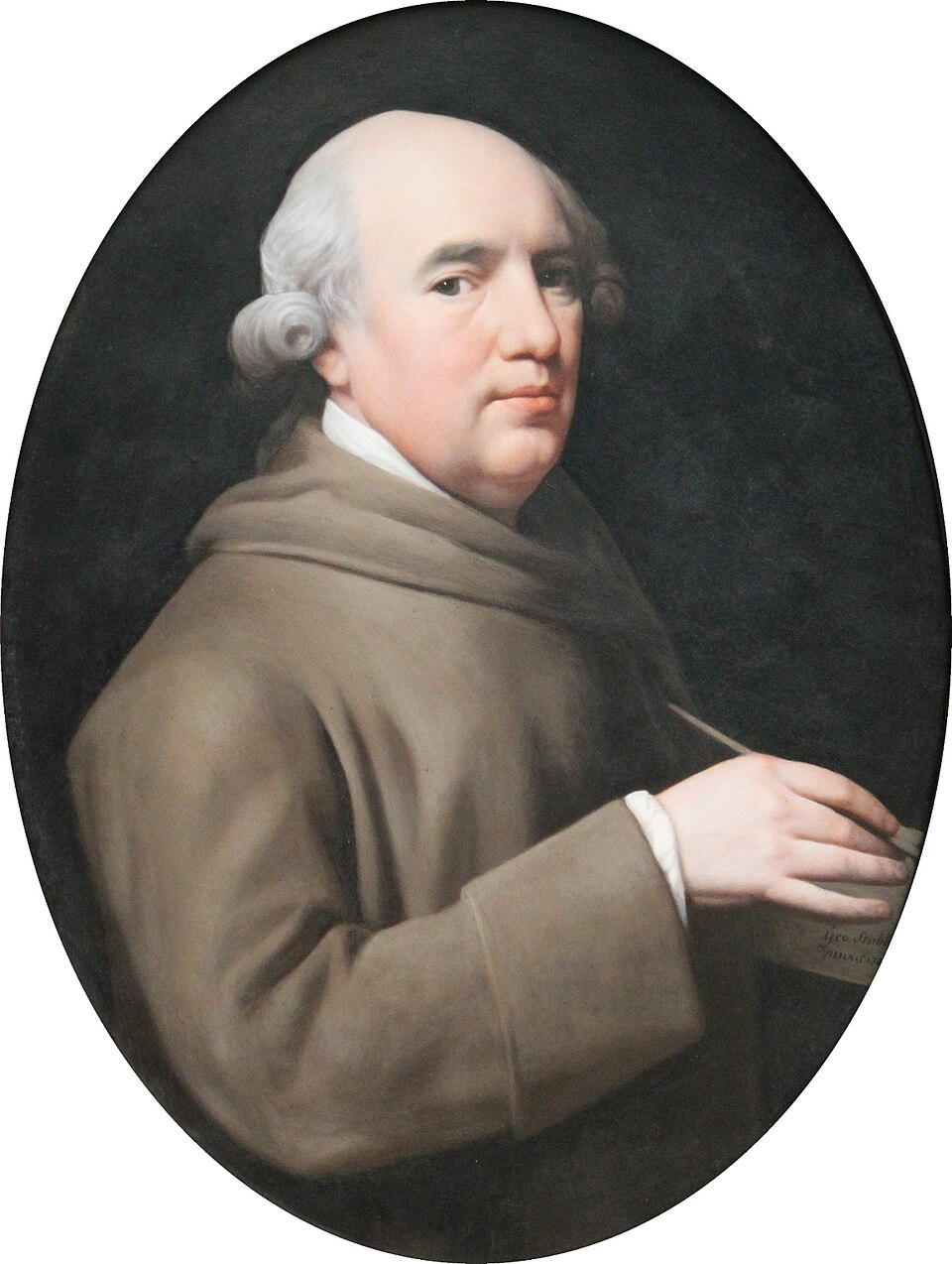
The first George Stubbs painting that stopped me in my tracks didn’t contain a horse.
Of course, Stubbs (1724 – 1806) is well known as Britain’s greatest painter of horses, and it’s what most people think of when you say his name, but he also painted portraits and a host of other animals (from the exotic to domestic pets).
That’s not what made me stop though; it was one of his Newmarket Heath paintings. An expanse of open land interrupted by the plain geometry of a rubbing-down house. Quiet, austere and oddly modern, it made me realise how I didn’t know Stubbs at all.
The horse painter who wasn’t just a horse painter
Stubbs is remembered for horses because he painted them better than anyone else but reducing him to a sporting painter misses something much more interesting about the way he worked.
He spent years studying anatomy, first assisting with illustrations for a work on human anatomy before dedicating himself to the meticulous dissection of horses. This wasn’t simply drawing as preparation for better paintings; his work reflects an Enlightenment belief that careful observation was a route to knowledge. He disliked being dismissed as simply a “horse painter”, and his career reflects an artist determined not to be confined by either subject matter or technique.
Stubbs’ investigations didn’t stop with anatomy. Alongside portraits, animal painting and landscape, he became fascinated by the materials of painting and the possibilities they offered. By the late 1760s he had turned to enamel painting, a technically demanding process in which pigments rich in ground ores and metal oxides were fired onto prepared copper to create a hard, glass-like surface. Unlike oil painting, the true colours of an enamel only emerged after firing, making every stage an experiment. Stubbs was not content simply to master an established technique; his surviving enamels suggest that he pushed the medium beyond its conventional palette and subject matter, adapting it to his own artistic requirements.
His curiosity led him beyond copper supports altogether, and frustrated by the limitations of their size, he began exploring the possibility of painting on large ceramic tablets. That search brought him into collaboration with the Staffordshire potter and industrialist Josiah Wedgwood. The partnership united two figures shaped by the same Enlightenment culture of enquiry: both believed that technical problems existed to be solved. After years of experimentation, Wedgwood succeeded in producing ceramic panels large enough for Stubbs’ purposes.
The Royal Academy, however, was reluctant to recognise enamel painting alongside traditional oil painting, a disagreement that contributed to Stubbs’ increasingly uneasy relationship with the institution. Even after returning to oils, his experimental streak remained. He altered his painting mediums with additives such as pine resin and beeswax to achieve the smooth surfaces he wanted; innovations that have proved something of a headache for later conservators trying to understand exactly how his paintings were made.
These continued experiments reveal an artist whose curiosity extended well beyond the accurate depiction of horses. Perhaps for Stubbs, painting wasn’t simply a means of recording the world; it was another way of investigating it.
The landscape that surprised me
Newmarket Heath, with the King’s Stables Rubbing House at the Finish of the Beacon Course (c.1765) is a small oil on canvas, just over thirty by forty centimetres, and made in preparation for a larger series of paintings featuring racehorses at Newmarket. Yet what first caught my attention is not the absent horses, but the landscape itself.
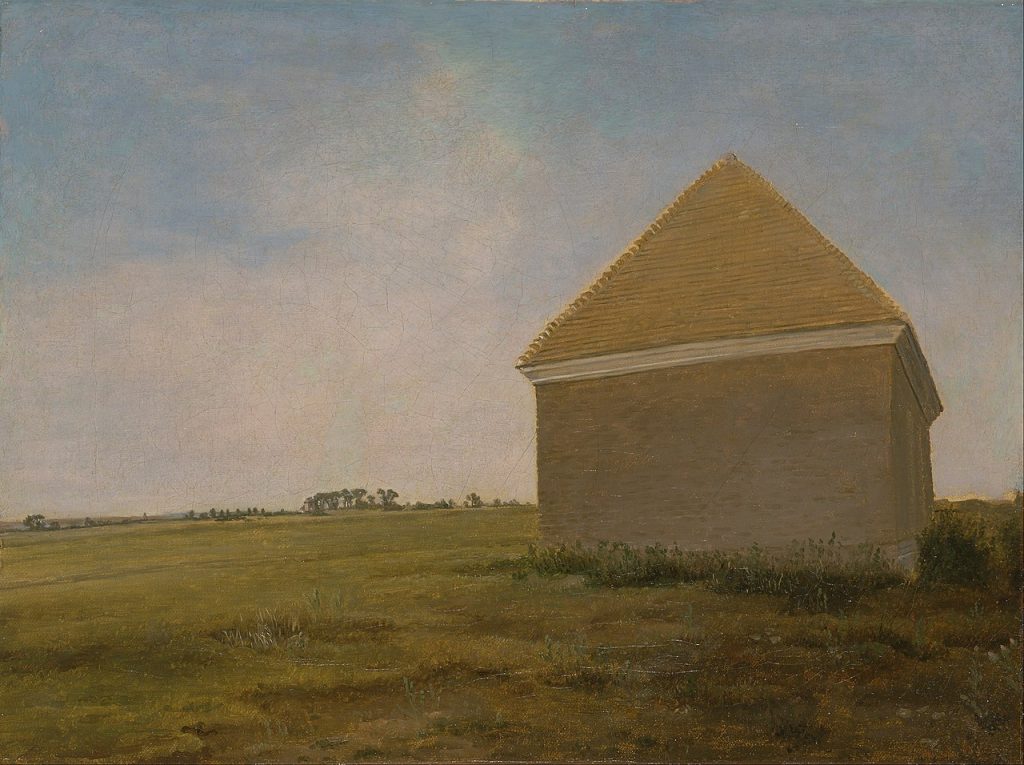
The low horizon gives over much of the canvas to a pale, hazy sky. The heath stretches into the distance, bound by a thin line of trees. There is little to interrupt its openness except a whacking, great brick building, filling the right of the composition. This is the rubbing house of the title: a practical building where horses would have been rubbed down with straw after racing. Stubbs doesn’t disguise it, it’s solid and self-contained, angular geometry standing against the scrubby, uneven heath.
The landscape itself is unassuming with tufts of rough vegetation around the building, and closed dandelion heads picked out among the grasses. The muted palette of earth browns, dusty greens and pale blues allows the building to belong to its surroundings rather than dominate them through colour, while soft light catches the roof and graduated shadows anchor the structure to the ground. There is no dramatic weather or picturesque device inviting the eye into the distance. Instead, there is an extraordinary stillness.
Looking more closely only deepens that impression. Individual brushstrokes describe the brickwork with surprising care, while the distant line of trees is rendered with equal precision. Around the edges of the building, however, the underpainting remains visible, reminding us that this is a preparatory study rather than a finished exhibition piece. That knowledge somehow changes the experience of looking. This was not a painting intended to stand on its own before an audience, and yet Stubbs has paid such close attention to it. It feels private, almost meditative: an artist working something out for himself rather than performing for a patron.
Stubbs’ paintings of Newmarket Heath, even those which are complete with horses, are extraordinarily restrained. What strikes me about them isn’t simply their emptiness, it’s their compositional confidence. Most eighteenth-century landscapes are interested in leading your eye through space with winding roads and clumps of trees, but Stubbs does something much stranger. He places this plain rectangular building in the middle distance and… leaves it there. The slight upward viewpoint lends the rubbing house an unexpected monumentality, while the angle of its roof draws the eye down and back across the open heath. The building neither dominates the landscape nor dissolves into it – there’s remarkably little attempt to romanticise it. The building isn’t blended into nature; it interrupts nature.
The result is something unexpectedly modern. Qualities we often associate with twentieth century painting: the huge areas of open sky, the reduction of anecdotal detail, the emphasis on shape over narrative or the refusal to make the landscape picturesque, are arrived at by Stubbs for eighteenth-century reasons.
A different way of looking
To understand why Stubbs feels so distinctive, it helps to place him alongside some of his eighteenth-century contemporaries. At a time when British art was defining itself, artists were asking a fundamental question: should great painting improve upon nature, or should it observe it more closely?
For Joshua Reynolds, first President of the Royal Academy, the answer lay in the Grand Style. Shaped by his study of the Old Masters in Italy, Reynolds argued that artists should look beyond the particularities of the visible world in search of a more universal ideal of beauty. Great art, in his view, should elevate nature rather than simply record it. Stubbs took a different path; although he exhibited regularly at the Royal Academy, he was never elected a full Academician. His paintings are rooted in close observation of real animals, recognisable landscapes and the ordinary architecture of working Britain, and in this, he reflects a broader shift within eighteenth-century British culture; one increasingly shaped by empirical enquiry and the belief that careful observation could itself lead to understanding.
That same spirit can be found in the work of Joseph Wright of Derby, whose dramatic paintings of scientific demonstrations and industrial innovation have become synonymous with the Enlightenment. Wright painted the culture of experiment; Stubbs practised it. His anatomical dissections, technical investigations into enamel painting and collaboration with Josiah Wedgwood reveal an artist as interested in investigation as representation.
The picture becomes more nuanced with Thomas Gainsborough. A founding Royal Academician, Gainsborough nevertheless resisted much of Reynolds’ theorising. Although portraiture paid the bills, his real passion lay in landscape, and his paintings reveal the same affection for the English countryside that distinguishes Stubbs from artists working in a more overtly classical tradition. The Royal Academy was never a single artistic voice, and artists rarely fit neatly into opposing camps.
Seen alongside Reynolds, Wright and Gainsborough, Stubbs emerges as more than Britain’s great painter of horses. His paintings adopt the habits of Enlightenment enquiry: observation, experiment and a belief that careful looking could itself produce knowledge. The Newmarket landscapes, the anatomical studies and the experiments with materials all speak to the same conviction; the label of “horse painter” begins to seem far too small.
Seeing Stubbs Differently
Before this painting, Stubbs was a name I associated with horses and little else. Looking more closely has changed that. I found myself noticing a rubbing-down house, researching experimental processes and anatomical dissections, and a painter whose curiosity extended far beyond sporting portraiture. None of those things replaces the horses; they explain them.
It’s a reminder that art history isn’t simply about acquiring more facts, it’s about learning to look differently. Once you begin to look closely, labels we’ve inherited like ‘horse painter’, ‘portrait painter’, ‘landscape painter’ start to dissolve, and the more you learn, the less familiar those artists become.
The first George Stubbs painting that stopped me in my tracks didn’t contain a horse. Having looked more closely, I’m not sure that was a coincidence.
Selected References
Egerton, Judy. 1984 George Stubbs, 1724-1806. (London: Tate Gallery Publications).
McKendrick, Neil. 1957. ‘Josiah Wedgwood and George Stubbs’ History Today, vol. 7, no. 8, p. 504.
Prown, Jules David. 2017 ‘The Art of George Stubbs (1724–1806).’ The British Art Journal vol. 18, no. 2, pp. 32–39.